95 Deep Philosophical Questions for High School Students
15
Any teacher who’s spent time with high schoolers knows how deep they can be. From inspired questions about the universe to well-crafted arguments about the value of homework, they are just starting to apply critical thinking skills to the world around them — even when they’re not trying to distract you from your lesson.
Keep those conversations going with a series of philosophical questions designed to get high schoolers thinking and talking. You may even find yourself pondering a few questions yourself as your students make their points!
High School Philosophical Questions About Life
Life happens pretty fast for high school students, leaving them little time to think about what they actually believe. Use these philosophy questions for high schoolers to discuss important parts of their lives in class, or as journal prompts for high school students to reflect on their day.
- Is love a real thing?
- Should children and adults follow the same morals?
- Is friendship important to society?
- Are parents true authority figures?
- What choices should teenagers have in their own lives?
- Which criminals are the most dangerous?
- Are we responsible for every choice in our lives?
- What is the value of having a high school education?
- Is friendship more important than family?
- What is true success?
- Does divorce unfairly impact children in a family?
- Is stealing always wrong?
- Should teenagers have as much freedom as they want?
- Is it a good idea to educate everyone in a society?
- Are crimes objectively bad, or are they just bad because we call them crimes?
- Is achieving true happiness possible?
- Does free will exist, or are our lives predetermined?
- Are coincidences real, or is fate real?
- Do children owe their parents for raising them?
- What’s the difference between self-care and selfishness?
- Is it better to blend into a group or be yourself?
- Are parents morally obligated to give their children a great childhood?
- Should all acts of kindness be reciprocated?
- Is it ever okay to lie?
- Are talented people morally obligated to use their talents to help people?
- Should effort matter as much as results?
- Who deserves respect?
- Is it easier to be one gender over another?
Use discussion starters for pair or group talks
Some philosophical questions make perfect long-form essay prompts, while others are best for starting conversations. Bring short discussion starters based on philosophical theories into your high school class to get kids talking to each other.

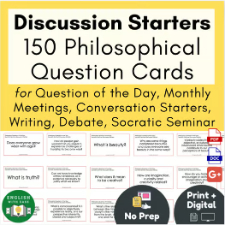
Discussion Starters | Philosophy Question of the Day Cards | Socratic Seminar
By English with Ease
Grades: 6th-12th
Subjects: English Language Arts, Reading
Standards: CCSS CCRA.R.1, 2, 4; CCRA.W.1, 2; CCRA.SL.1, 2, 3, 4, 5
Use a CCSS-aligned set of philosophical question cards for high schoolers to get to the truth of the matter in nearly any subject. With 150 questions, the resource encourages individuals or groups to think deeply about any number of topics and school settings.

Conversation Starters on Philosophy | Middle/High School Discussion
By English Education Lab
Grades: 7th-12th
Subject: English Language Arts
This thorough, in-depth resource includes 15 questions on free will, justice, and the meaning of life for high schoolers to answer, as well as feedback forms, a teacher discussion evaluation form, and helpful note-taking templates.
Political Philosophical Questions for High Schoolers
Are you looking for ways to address hot topics in politics without starting arguments? Skip the details and move on to the greater philosophical issues with questions on politics, law and order, and morality, which work well as discussion prompts or debate topics for high school.
- Is it immoral to treat animals like property?
- Should felons be allowed to vote?
- Do citizens have a duty to overthrow corrupt officials?
- What war crimes shouldn’t ever be allowed?
- Should society listen more to underrepresented groups when making laws?
- Is a government morally obligated to provide its citizens with the basics to sustain life?
- When is war appropriate?
- How much should the wealthy support the poor?
- Is it showing appreciation to wear clothes from another culture, or is it cultural appropriation?
- Are compulsory taxes immoral?
- Do societies need laws to function?
- Are all people morally obligated to follow the law?
- Does justice serve everyone equally?
- Should corporations have voting rights?
- What role should the government play in ensuring equality for all?
- Is voting the absolute best way to choose a leader?
- Does everyone deserve equal rights?
- Is it moral to commit a crime that saves a person’s life?
- Are justice and fairness the same thing?
- How much control should the government have over people’s lives?
- When is it appropriate to judge a person for their criminal past?
- Should insects be treated with the same respect as dogs and cats?
- How much power is too much power?

Hot Topic Discussion Stations for Secondary English
By Room 213
Grades: 8th-12th
Subject: English Language Arts
These discussion stations are the perfect speaking and listening activity to get your students engaged and discussing hot topics. Students will take turns leading the discussion. They can play an optional video and then read pertinent facts to the rest of the group. The other students will take notes and then engage in a discussion about the topic. Afterward, they will do a peer and self-assessment.
Science-Based Philosophical Questions for High School
Science isn’t just limited to traditional topics like biology. Today’s teens are equipped with advanced technology in their pockets, often without understanding the philosophical issues connected to it. Coupled with modern advances in medicine and communication, learning about science-based philosophy is more important than ever! Use these questions to get students thinking about how science affects their everyday lives.
- What is the highest value technology brings to society?
- Which is more valuable: logic or creativity?
- Do some aspects of existence defy science?
- Is technological invention moving faster than humanity can adapt to it?
- Who doesn’t need a cell phone?
- Would it be immoral to choose a child’s DNA before they’re born?
- Does technology damage childhoods?
- If time travel were real, should everyone be able to use it?
- Could more than one universe exist?
- When should lifesaving medical techniques be used?
- Do AI mechanisms deserve the same rights as humans?
- Should the goal of medicine be to keep people alive as long as possible?
- Would it be beneficial to society to vaccinate people against fears?
- Is cloning immoral?
- Would it be moral to steal internet access to perform a public good?
- Does true evil exist?
- Why does understanding the origins of the universe matter?
- Are animal experiments immoral?
- Is it moral to use remotely controlled unmanned vehicles in battle?
- Who should get priority in emergency medical treatment?
- Should scientists ignore or embrace their intuition?
- Is technology equalizing or polarizing?
- If aliens exist, should they be treated equally with humans?
- Does social media meet or create a need for connection?
Philosophical Questions for High School Social Studies
Philosophical questions aren’t limited to the 21st century! Take students back through history for a glimpse at philosophy from centuries past — and even the beginnings of philosophy itself! These questions help high schoolers apply their modern thinking to issues throughout history, as well as other subjects in social studies like psychology, education, and sociology.
- Is written history too biased to be credible?
- Are humans obligated to pass their knowledge along?
- How much control should a person have over their legacy?
- Should all children be required to receive a K-12 education?
- Is art or writing a more accurate depiction of a culture’s values?
- Should parents or teachers decide what’s taught in school?
- Are we happier now as a species than in the past?
- Is it moral for teachers to require students to finish homework?
- Why is it important for society to study history?
- Is it worth students’ time to learn philosophy?
- Should students object to lessons they disagree with?
- What is the main responsibility of the modern educational system?
- Are humans obligated to help other humans?
- Has historical urbanization hurt or helped society?
- Is humanity working toward a goal throughout history?
- How much does society influence an individual’s personality?
- Is progress the most important theme of history?
- Who decides what’s put into a history book?
- Should teachers be held to a different moral standard than other adults?
- Is the modern grading system moral?
Get students thinking about epistemology
By high school, students know how to learn, but do they know the nature of knowledge itself? Bring the theory of knowledge into your classroom with a study of epistemology, along with discussion prompts that encourage students to think about the way they think.

Philosophy Discussion Prompts and Thought Experiments Bell Ringers High School
By The Unraveled Teacher
Grades: 10th-12th
Subjects: Social Studies
Ideal for IB-level high school social studies classes or college philosophy courses, this resource includes 16 discussion starters focused on the theme “Being human.” Each slide includes speaker notes along with the questions, giving students important context for the epistemological questions they’re about to discuss.
How to Use Philosophical Questions in High School
Once your curriculum includes philosophy questions, you’ll find that your instruction is richer, deeper, and more engaging for all high school students. So how do you fold these questions into your everyday classes? Try out these tips for incorporating philosophy into any class or subject:
- Host a formal Socratic seminar centered on a philosophy question and student responses to it.
- Start the class period with questions of the day for high school students.
- Use questions based on philosophy as writing prompts for long-term papers.
- Have groups rotate through stations that discuss different philosophical prompts.
- Offer extra credit for well-considered written philosophical responses to a question raised in class.
- Use philosophy questions as essential questions that match the theme of a class novel or upcoming unit.
Teach reason and respect in the same lessons
When students can think critically about philosophical issues in the world, they become better listeners — and better learners. Find more high school philosophy resources to inspire teens in thinking about the way they reason. Make philosophical reasoning a regular part of your lessons on life skills activities for high school students to keep that deep thinking going long after graduation.