How HBCUs Plan to Spend MacKenzie Scott’s Money
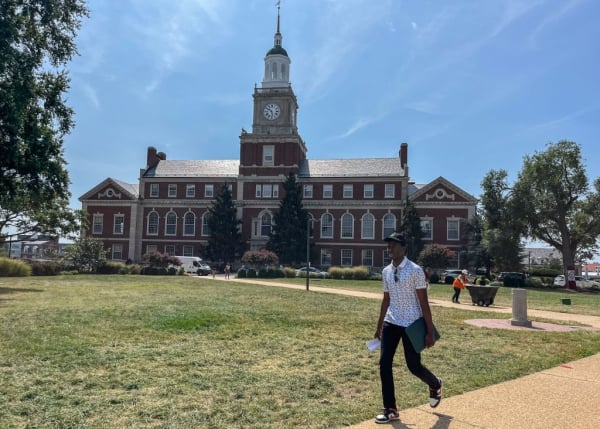
Philanthropist MacKenzie Scott showered historically Black colleges and universities with hundreds of millions of dollars this fall in another one of her signature giving sprees. HBCU leaders say the unrestricted lump sums are a godsend after decades of chronic underfunding—and they’re putting them to good use, padding previously meager endowments and funding a wide variety of technology advances, research ventures and scholarships.
Scott, the ex-wife of Amazon founder Jeff Bezos, has repeatedly poured funds into often underresourced institutions, including HBCUs, as part of a 2019 pledge to give away half of her wealth in her lifetime. Her largess to colleges and nonprofits has come in waves since 2020. By 2023, her gifts to educational institutions and nonprofits exceeded $1 billion.
At HBCUs, those funds led to new research centers, endowed chair positions and more aid for students, among other initiatives. Some institutions, like Bowie State University, saved and invested the money, benefiting them years down the line.
Scott’s latest round of donations to HBCUs includes some whopping sums: $80 million to Howard University in Washington, D.C.; $38 million to the University of Maryland Eastern Shore; and $38 million each to Spelman College and Clark Atlanta University in Georgia. Scott gifted $50 million to Virginia State University, $42 million to Alcorn State University in Mississippi, $38 million to Alabama State University and $63 million to Morgan State University in Maryland, marking the largest individual gifts in their histories.
The United Negro College Fund, an organization representing private HBCUs, also received $70 million from Scott toward its capital campaign to create a $370,000 pooled endowment for 37 institutions. The sum, announced last month, will be distributed among HBCUs in the pool.
Notoriously private, Scott has spoken little about why HBCUs have loomed so large in her philanthropic portfolio. But in a 2021 blog post, she called higher ed “a proven pathway to opportunity” and said she sought to bolster institutions “successfully educating students who come from communities that have been chronically underserved.” She also had close ties to Howard alumna and author Toni Morrison, who served as Scott’s thesis adviser at Princeton University.
Scott cited everyday “acts of kindness” as her inspiration for her recent gifts in a post last month.
“When my next cycle of gifts is posted to my database online, the dollar total will likely be reported in the news,” she wrote, upward of $300 million to HBCUs alone, “but any dollar amount is a vanishingly tiny fraction of the personal expressions of care being shared into the world this year.”
HBCU leaders say that “tiny fraction” has gone far for their institutions.
Scott “really understands the value that these institutions have historically made to the overall competitiveness of our country,” said David K. Wilson, president of Morgan State University. She’s “making transformational investments in these institutions that will enable them to continue to provide in perpetuity opportunities for students to taste the magic of a college degree that will enable them to live productive and prosperous lives.”
Brent Swinton, vice president for philanthropic engagement at Bowie State University, which received a $25 million gift from Scott in fiscal year 2021, emphasized how rare unrestricted grants are for any institution, let alone HBCUs.
“Unrestricted gifts are the unicorn, the white whale of the fundraising industry,” he said. Scott is “single-handedly saying to HBCUs, ‘Here is an investment for those who already are getting it right but just haven’t had the same opportunities to be in the conversation with philanthropists.’”
New Ventures
With fresh funds in hand—and the freedom to use the dollars how they choose—HBCU leaders are dreaming up new plans.
Morgan State University put $60 million into its unrestricted endowment. Wilson expects that investment will generate an extra $4 million to $5 million per year for the university and its students going forward. Wilson also set aside $1 million to immediately support its most cash-strapped students. The institution reached out to 2,100 students with “severe financial need,” and already, 600 students have requested the funding to help them finish out the semester.
The university has plans to create a new brain science research center as well, adding to the research centers it established with help from the last grant from Scott in 2020. Morgan State used part of that $40 million grant to win state appropriations for its National Center for the Elimination of Educational Disparities and its Center on Urban Health Equity.
The university is filling those centers with “faculty members who will be churning out original research that’s coming from the perspective of researchers who really understand what some of those challenges are within our communities that are preventing the students from achieving their full potential,” Wilson said. He partly credits Scott’s gifts for Morgan State hovering on the precipice of R-1 status, the Carnegie Foundation classification for universities with very high research activity.
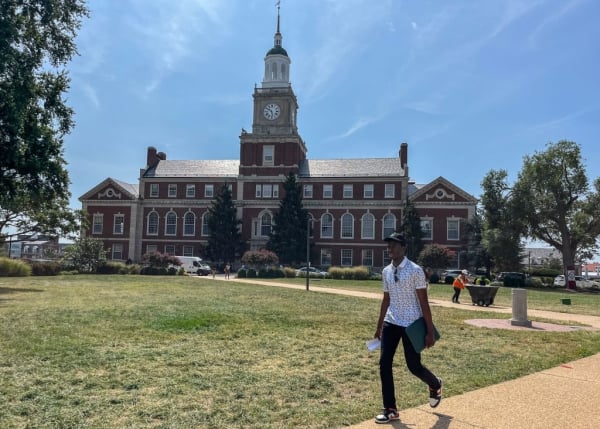
Howard University received $80 million from Scott.
Andrew Caballero-Reynolds/AFP via Getty Images
Howard University became the only HBCU to attain R-1 status earlier this year. Now, about $17 million of Scott’s donation to Howard is earmarked for its College of Medicine, to expand it and establish a new academic medical center. Howard also plans to invest in capital construction and renovation projects, including new residence halls, and to create a reserve in response to the government shutdown. Interim Howard University president Wayne A. I. Frederick said students are affected by delays in federal food benefits and layoffs and furloughs of federal employees in their families. Federal appropriations to Howard have been waylaid, as well.
“We want to give students some temporary relief,” Frederick said.
Spelman College’s interim president, Rosalind Brewer, emphasized that these gifts come at a time of “quite a bit of uncertainty in higher ed” as federal policy changes roil institutions. She said the $38 million to Spelman offers her flexibility in how to respond.
Unrestricted gifts are the unicorn, the white whale of the fundraising industry.”
—Brent Swinton, vice president for philanthropic engagement, Bowie State University
For example, Spelman plans to put some of the funding toward new scholarships, particularly for juniors and seniors who rely on Parent PLUS loans, which will be capped starting next year due to the One Big Beautiful Bill Act. The goal is to close financial gaps for juniors and seniors who may struggle to pay to finish their degrees. Spelman also spent a previous gift from Scott, $20 million given in 2020, on student scholarships, as well as its endowment.
“Some days, we don’t know what we’re going to face the next day,” Brewer said. The donation “gives us the confidence that, come what may the next morning, we just may be a little bit more prepared.”
The gift to Spelman will also support an effort to improve classroom technology, including new tools to teach artificial intelligence skills to students. The college came out with a technology road map last month that it’s eager to get started on with the new support.
An unrestricted gift “allows us to look at our strategic plan and apply it to where we know the money will work best for us,” Brewer said. “That makes this donation, quite honestly, a lot more generous than most people would realize.”
Lasting Effects
HBCUs that received funds from Scott in years past say the gifts are still paying dividends.
Bowie State University invested $22.5 million of its $25 million gift into its endowment. At the time, the endowment stood around $8 million. Four years later, it’s surpassed $49 million, buttressed both by Scott’s giving and other philanthropic donations that followed her “vote of confidence,” Swinton said.
He noted building up endowments has been a longtime goal for many HBCUs but hard to achieve.
“Endowments are not sexy, but they are lifeblood and the nest egg for an institution,” he said. “If you took all 103 HBCU endowments and added them up today, they still wouldn’t come close to any of the top 10 endowments of [predominantly white institutions].”
Bowie State took the $2.5 million left over and used it to apply for matching grants from other philanthropies that it wouldn’t have had the funds to qualify for in the past. One of those partnerships enabled Bowie State to create its first endowed chair position in cybersecurity and innovation.
“We look to do more of that, to be able to establish positions that will build our infrastructure, that now have a source of permanent funding, instead of being completely reliant on whatever the state budget allows” as a public HBCU, Swinton said.
Frederick, of Howard University, said he also feels a lasting impact from Scott’s past gifts in 2020 and 2023, $40 million and $12 million, respectively. Those funds enabled Howard to set up the Toni Morrison Endowed Chair in Arts and Humanities and to spread the wealth, creating a $500,000 scholarship for graduates of the University of District of Columbia, a local HBCU that didn’t get Scott funds, to attend Howard’s graduate and professional programs. Howard also increased its emergency aid funding for students.
Scott is “doing things so differently,” Frederick said. “It provides us with a lot of freedom to do what we need to do.”