Being A College Professor In Trump’s America
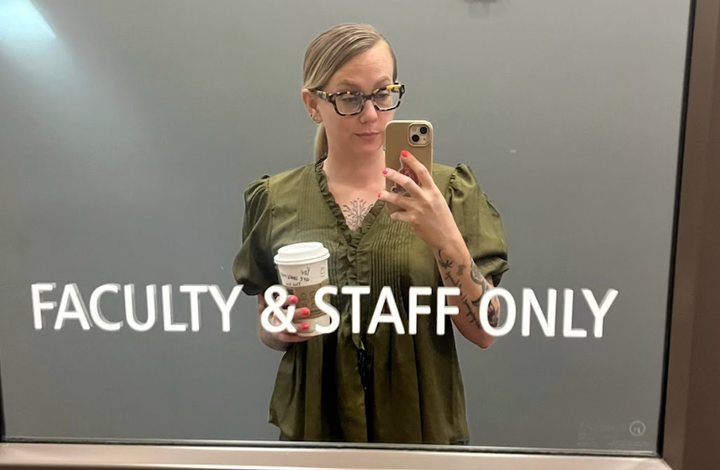
I never used to sweat like this.
Nearly a decade ago, in a small Texas town with a crystal-clear river running through it, a university student came to my office with a Bowie knife sheathed at his hip. I didn’t notice it until we were almost through discussing the torrent of comma splices diluting his essay.
“Next time, don’t bring a weapon to my office,” I said as he left.
He offered a casual apology. The behavior was jarring, but back then, it was just part of the scenery — abrasive, but toothless.
During my tenure in Texas, my colleagues and I were advised to add campus carry policies to our syllabi. It was a futile, bureaucratic effort to regulate state-sanctioned firearms in our classrooms. Texas legalized open carry in most public spaces, but it was (and still is) prohibited on university grounds. Concealed carry, on the other hand, was legal for any student over 21 with a license. It felt perverse to parse through gun legislation as an educator — let alone codify basic human decency in a syllabus — but there I was. In America, the threat of violence is constant, but in the South, it’s especially ordinary.
Collegiate positions in “Come and Take It” territory require a tough, unyielding spirit. That is to say, working with and for folks who view critical thought as a grievance is no easy task.
“The first Trump administration and its debilitating fallout were a naïve rehearsal for what Project 2025 and a second, draconian Trump term had in store.”
I felt I was built for it in some respects. Conflict was a constant growing up. An artistic, contemplative but ideologically headstrong kid, I quickly ascended to black sheep status in a rigidly structured Air Force family that valued acquiescence above all else. A fraught, unsafe upbringing steeled me against an aversion to confrontation at the very least — a sort of maladapted resilience.
That in mind, the strategy I developed as a new adjunct professor was threefold: Be commanding, judicious and empathetic. As a young-ish woman with sleeves of tattoos, a baby face and progressive values in a tenaciously conservative place, my mask of unshakability was paramount.
My lesson plans followed suit. I wrote my curriculum like armor, confident that its rigor, relevance, merit and scope would counter the deep-seated local fears of “liberal indoctrination,” the same rhetoric I had grown up with, as vigorously enforced by my father.
Those initial Introduction to Composition students didn’t simply read and write in my class; we dissected logical fallacies in political debates and deconstructed feminist discourse via bell hooks, Roxane Gay, Chimamanda Adichie, and Beyoncé. I never shied away from controversy or complexity because those are the discussions that matter most, and I reveled in my ability to steer them. I had so much fight in me.

Courtesy of Melanie Robinson
In 2019, I was still teaching freshman writing courses at the same college in the teeth of the first Trump presidency while finishing my master’s degree in poetry, the mother of all esoteric focuses. This was on the eve of a global pandemic, a tragedy and collective trauma that would be swept aside in a grotesque rush to return to normal in a matter of years.
Volatility is the baseline in Texas, but tensions were swiftly ratcheting during this time. I remember when racist posters were wheatpasted across campus, and white supremacist propaganda was littered about — sadly, nothing new for the Lone Star State. That same year, our university’s student government tried to ban the local chapter of Turning Point USA, arguing it posed a threat to the student and faculty bodies. Gov. Greg Abbott then threatened the university’s taxpayer funding and mandated that all public campus grounds be opened as forums. I hadn’t heard of Charlie Kirk then, but the name would resurface soon enough.
Remarkably, those days seem tame in retrospect. The first Trump administration and its debilitating fallout were a naïve rehearsal for what Project 2025 and a second, draconian Trump term had in store. Thus far, the horrors include relentless attacks on DEI, masked ICE agents abducting and shooting our neighbors, the gutting of institutions like the Department of Education, the grim debris of the Epstein files, AI/Large Language Models and their monstrous impacts, and so, so much more.
According to extensive reporting from PEN America, a leading nonprofit advocating for academic freedom, state legislators introduced 93 bills across 32 states in 2025 aimed at restricting higher education, reflecting broader concerns about ideological government control. Of those bills, 21 became law in 15 states. PEN America notes that “State legislatures set three new records in 2025: the highest number of new laws censoring higher education enacted in a single year (21), the highest number of states enacting them (15), and the highest number of states enacting their first higher education censorship law (8).”

Courtesy of Melanie Robinson
It’s the fall of 2025, and I’m sweating profusely.
Time, distance, and a few professional pivots have brought me back to the head of an English college classroom, this time in California. This go-round, though, I’m wondering how you’re not supposed to let them see you sweat when perspiration is, in fact, very visible. I’m choking at the whiteboard under fluorescent lighting, stammering my way through my meticulously structured “Satire as a Rhetorical Device” presentation. Comedy can be contentious, so I’m anticipating some pushback, but my fear is of a more existential variety. Can these students even handle irony and political satire in this climate?
Charlie Kirk had been shot on a school campus in Utah a week and a half earlier. A student talks with me after class about the topic of his essay, a narrative-style piece about finding his religious faith through, you guessed it, Charlie. Aside from the logistical issues of writing an essay about an unfolding tragedy, his premise was tenuous; oh, and my response may jeopardize my career. Professors in California and across the country were being abruptly ousted for Kirk-related comments, both in and out of the classroom.
“Did you say anything about it in class?” I asked a colleague after the assassination.
“No. It doesn’t have to do with our class, and they are all adults,” he said.
It’s repeatedly suggested that I cut back on political content to ease my escalating nerves. But between a few Crooked Media podcasts and the New York Times push notifications, my media diet feels tame, relatively speaking. What a privilege to compartmentalize. How misguided to think that you are somehow excluded from your environment — the “illusion of immunity,” as it’s called in addiction rehabilitation programs (rugged individualism as it’s called in America).
As Wisława Szymborska wrote in her poem “Children of Our Age,” “Whatever you say reverberates, / whatever you don’t say speaks for itself. / So either way you’re talking politics.”

Courtesy of Melanie Robinson
Mid-semester in California, I’m asked to pick up an extra class following an abrupt faculty departure. This in medias res exit is considered scandalous in higher education, reserved for only the most acute crises. The circumstances were odd and unclear. I’m told not to contact the previous professor, and the classroom is heavy with rumor and ominous unease. I’m left to salvage a class already in disarray a third of the way through the semester, while navigating the bigoted policies of an autocratic regime and a crumbling educational institution. The tension in the air is almost tangible, a layer of silt.
I pictured California classrooms safer, brighter, shining with the promise of progress, but the threat of physical and/or ideological violence bristles again — a serrated déjà vu. Self-censorship in teaching is rampant, and I’m anticipating sanctions or backlash at every corner. Every American teacher is Sisyphus to some extent, but each day brings with it heavier boulders that test courage and patience, and I’m not sure my center will hold. That callused disposition I cultivated years ago fractures, making way for a crisis of confidence unlike any I’ve experienced before.
“I spend nights combing through my course calendar again and again to hedge against which benign assignment could be weaponized as partisan provocation.”
Some weekdays, I work 13 hours, six of which are spent commuting between two colleges to teach three classes total (one of the many joys of an adjunct’s status in a take-what-you-can-get economy). I’m not sleeping or eating, and the likelihood of physical exercise has long since dissipated. If I’m not grading, I’m lesson-planning; if not lesson-planning, I’m managing my small content writing business or struggling to publish my own writing for a few pennies on the dollar. I don’t have health insurance, living wages or a guaranteed position.
I spend nights combing through my course calendar again and again to hedge against which benign assignment could be weaponized as partisan provocation, preemptively altering my course materials in response. Suddenly, I’m doubting whether neutrality is even possible in a culture softened to such aggressive conservatism. Yielding to the morally misled masses is soul-crushing work, and I hate myself for bending for them. The question then becomes: Is teaching college financially, spiritually, or even physically sustainable? What is sustainable at a time like this?
The middle ground is paved over, and the insidious ideological erosion of Trump 2.0 is now in full swing. Professors are purged for philosophical orientations, teaching assistants are removed for secular academic standards, and my TikTok feed is inundated with clips of students hijacking lectures or teachers “crashing out.”
At Texas A&M University, a philosophy professor was even instructed to remove some of Plato’s writings from his syllabus because they touched on race and gender. And let’s not forget the Compact for Academic Excellence in Higher Education, wherein our federal government asked nine schools to agree to funding-dependent conditions, echoing the McCarthy-era loyalty oaths.

Courtesy of Melanie Robinson
The entire higher education ecosystem is now compromised, from research funding and student loan programs to the national accreditation system, curriculum planning, and the attraction and retention of international students and faculty. While deterioration of institutions is hardly swift, as PEN America notes, “in both quantity and quality, the second Trump administration’s assault on higher education is without precedent in modern American history.”
I, like so many educators, am defeated, depleted and disheartened. In what has historically been a thankless job in the United States, the latest iteration of challenges is absolutely untenable.
Maybe the flashbangs from the summer protests in downtown Los Angeles are still ringing in my ears. Maybe my students’ essays about ICE dragging away relatives, or about the American flag functioning as a co-opted symbol of white nationalism, have shaken me. Or, perhaps the weight of a terrifying reality has caught up with me: Maybe my foundational mythologies of academia, America, and goodness more generally have imploded. Salvaging those ideals seems more and more unlikely each passing day.
I returned to teaching to engage with a culture in crisis the only way I know how: studying the craft of writing as an intentional practice integral to critical thought. To write, one must think through, around, and for long periods of time about complex topics without clear answers, and then communicate with clarity and impact. Doing it well demands tremendous time and effort; it isn’t efficient, but it is worthwhile. Combine that with compassion, respect, and an insatiable curiosity disciplined by reading, and I’m convinced a more accurate way of seeing will lay itself bare before most of us. Reading, thinking, writing — these are meaningful, beautiful, and everything in our relentless modern world wants us to abandon them.
Education was initially a place of solace for me to escape a violent, unsafe upbringing. It gave me a vocabulary to talk about myself, my life, and the world around me. It was a stable shelter that provided a window into the world. School libraries held me tightly, and I often hid inside them as if it would save me.
Teaching then became a way for me to survive the first Trump administration and fight for my community. What can I say? I’m a reformist who watched “Dead Poets Society” and “Mona Lisa Smile” at an impressionable age, and it shows. If educators lose hope in the fragile possibilities found in places like these, I fear there’s no turning back.
I feel myself slipping, giving way to a sense of powerlessness in a country that seems to care less about its people each day, and I’ve only been back in higher education one semester. In a profession riddled with overwork, underpay and precarious (often contemptuous) working conditions, countless teachers are facing the same despair. I often think of my friends teaching in Texas and those in the South more broadly. Their struggle is a bare-knuckle brawl, and I fear what comes next.

So, what now? How do we foster analytical reasoning, teach critical thought, or encourage empathy in a collective fugue state? What do we do once the bullies win, paint everything gold, and make patriots of racists? How does one defend truth when liars and thieves are applauded? In a culture that consistently chooses depravity over humanity, what is the impetus for young people to do better? On top of it all, how can we possibly keep our educators and students safe under such conditions?
Despite the grief, there was much to be proud of in that autumn 2025 semester. In my courses, my students wrote by hand daily. We read complex, unconventional texts, including Mary Ruefle’s “Pause,” a lyrical essay about menopause, which felt revolutionary assigning to young men, in particular. We tackled Susan Sontag’s “Notes on Camp,” attempting to pin down the elusive, dense essay. My students took to David Foster Wallace’s “This Is Water” and “Consider the Lobster” more than I anticipated.
Students also engaged with substantial reporting on AI, including its effects on critical thinking, productivity, the environment, personal and romantic relationships, and even “AI slop,” by way of John Oliver. Their AI-themed argumentative essay was then written by hand, in person, both due to the sheer amount of AI being used and as a deliberate form-follows-function lesson.
Maybe that’s enough to be proud of. Maybe that’s also what fortitude looks like.
Last semester, my students wrote some of the most delightful, inventive, thoughtful prose I’ve come across in years; their flourishing was remarkable. Our discussions sustained me when not much else did, and they trusted me to lead, though my confidence was waning. As I told them on our final day, it was an absolute pleasure to make sense of the world alongside them.
At the helm once again, now during the 2026 spring semester, I’m torn, and I’m aching. Perhaps there is glory in what one can withstand, but some part of me yearns for ease. These students deserve a fighting chance, but the fight shows no signs of slowing.
Melanie Robinson is a poet, essayist, pop culture critic and educator whose work examines the intersections of mental health, trauma and performative femininity. She grew up in San Antonio, Texas, and holds an MFA in poetry from Texas State University. She was the 2019–2020 Poet in Residence at the Clark House in Smithville, Texas. Melanie is currently an adjunct English professor in Los Angeles, where she also works as a film critic. Her writing has appeared in HuffPost, The Rumpus, Polyester Magazine, and FLOOD Magazine. She spends her off-hours crafting erasures out of old texts and worshipping at the altar of John Waters.
Do you have a compelling personal story you’d like to see published on HuffPost? Find out what we’re looking for here and send us a pitch at pitch@huffpost.com.