UC Davis Library Emerges as Campus “Third Place”
Bill Garrity still remembers the moment last fall when the University of California, Davis, library transformed into a performance hall. A quartet played beneath its high ceilings, the strains of a medieval-style guitar echoing among the stacks.
“That was the most profound moment for me,” said Garrity, the university’s librarian and vice provost of digital scholarship. “Students were walking by, stopping and going, ‘What’s this?’ and I would watch them texting their friends to come down from the upper floors to see the performance.”
“That was an experience I don’t think these students would have had otherwise because they were in the library,” he said.
Increasingly, UC Davis students are turning to Shields Library not just to study but to attend musical performances, meet with mental health ambassadors, cuddle with therapy dogs and engage in other activities. Campus leaders say it has become a “third place”—a term coined by sociologist Ray Oldenburg to describe a space beyond home and work where people gather, connect and belong.
Amid broader discussions about the disappearance of third places—particularly during the COVID-19 pandemic—the role of community as a public health necessity has gained renewed attention. College libraries nationwide have increasingly stepped into that void. At Boston University’s Mugar Memorial Library, for example, clubs hold meetings, groups rent out event spaces and campus services host pop-ups.
The University of Louisville’s Ekstrom Library has similarly embraced the third-place model with a coffee shop and socializing area. Boise State University’s Albertsons Library also fosters community by offering a family study room where student parents can focus while their children play and read.
At UC Davis, “the library is intellectually, organizationally and physically at the heart of campus,” Garrity said. “It’s a place where people spend a lot of time and absolutely serves the whole campus—all students, all faculty, all researchers, all disciplines.”

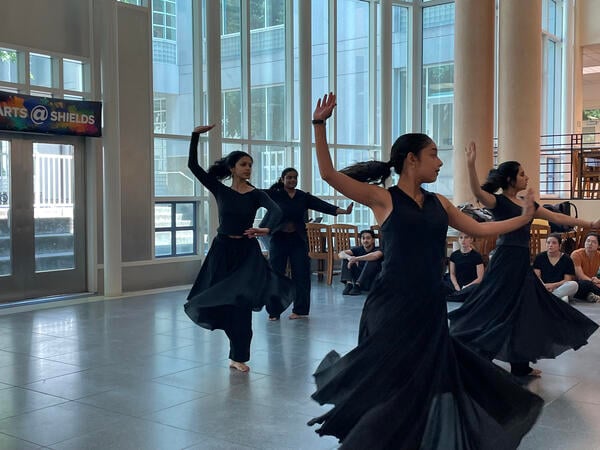
UC Davis students perform a dance as part of the campus library’s effort to create a vibrant “third place” for connection and creativity.
University of California, Davis
Libraries as third places: In addition to hosting programs, the library also deploys mental health ambassadors to engage students in conversation, promote stress-relieving activities and connect them with resources, Garrity said. The goal is to help destigmatize seeking support.
“The library is already that comfortable place for students,” Garrity said. “And if you’re struggling, or your colleagues and fellow students are struggling, there’s a certain barrier to having to go across campus to the student health center.”
The library also partnered with the campus tutoring center to repurpose the lower-level reading room into a centralized tutoring hub.
“The tutoring center used to have this awkward footprint that was somewhat hard for students to find,” Garrity said. “We already teach students how to find, manage and use information. The tutoring center is in the same business as we are, so by partnering with them, we were able to renovate the lower-level reading room into a tutoring center.”
“It was a win for the library, the tutoring center and—most importantly—the students,” he added. “They now have much easier access to support in a place they’re already spending time.”

UC Davis students visit the library’s lower-level reading room for tutoring and academic support.
University of California, Davis
Why this works: Garrity said that even in the age of artificial intelligence, libraries will continue to play a central role on campus.
“You hear about this all the time—AI is going to disenfranchise and make libraries, journalism, you name it, irrelevant,” Garrity said. “My strategic emphasis on the library as a third space is an effort to demonstrate to my colleagues across campus that the library as an organization and as a place is more important and more central to the life of the university than ever.”
Ultimately, Garrity said, the vision is to make the library a space where students grow—not just study.
“If I can help a neuroscience student gain exposure to the broader cultural and academic contributions of this campus, then I think that student will be a richer, more well-rounded person,” he said. “Someone who may not have been expecting it—but who becomes a more capable contributor to the workplace, to civic life, to corporate life and to academic life.”
Get more content like this directly to your inbox. Subscribe here.