Building a Rural Dental Workforce
Kyla Marks’s grandmother grew up in a small rural town in Mississippi where access to dental care was scarce—a gap that left her without most of her teeth by the time she was in her mid-30s.
“When I came into this world and met her, I never really saw her smile,” said Marks, a fourth-year dental student at Meharry Medical College, one of the nation’s oldest and largest historically Black medical schools.
When her grandmother died in 2020, Marks carried that loss with her, determined to expand access to dental care in underserved communities.
“Having a focus in rural areas is really important because sometimes they’re scared to go to the dentist,” Marks said. “I’m not able to restore my grandmother’s smile, but with my patients, I treat them like they’re my own family members. Just showing them love and care—having that small interaction—can really change their trajectory.”
Marks is one of more than 300 students in Meharry’s dental school. Since 2018, the institution has expanded its reach beyond its home base in Nashville, positioning itself as a critical provider in rural health-care deserts across Tennessee.
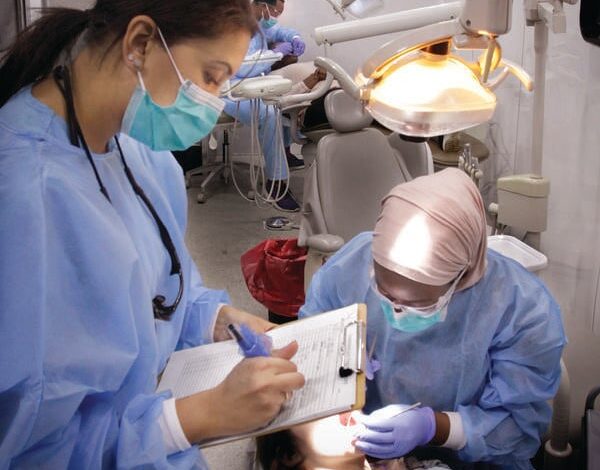
Meharry’s mobile dental units have traveled to underserved communities throughout the state. Last year alone, providers performed more than 4,000 dental procedures across Tennessee.
The mobile dental expansion comes at a critical moment for rural health: Nine hospitals in Tennessee—and roughly 300 nationwide—are at risk of closure due to funding cuts in last year’s One Big Beautiful Bill Act, leaving many communities with shrinking access to care. In that landscape, Meharry has become a leading provider in many rural communities, including among predominantly white populations that might not traditionally seek care from an urban-based, historically Black medical school.
The effort reflects Meharry’s long-standing mission, said Julie Gray, associate dean of external affairs at the college, who leads its mobile efforts.
“Many of our patients are white and they love us no differently—and we serve them no differently,” Gray said. “Teaching our students how to serve people, restore confidence, build trust and patience, is what we do, no matter who the patient is.”

Meharry’s mobile dental units performed over 4,000 dental procedures across Tennessee last year.
Supporting underserved communities: Gray said Meharry’s mission-driven approach treats health care as a civic right—a model for the way medical schools can strengthen rural health infrastructure.
In practice, that includes reaching populations often overlooked by traditional systems. For instance, Meharry’s mobile units provide a critical dental lifeline for youth in state custody, traveling directly to state-supported facilities so vulnerable children do not fall through cracks in the system.
“Mobility is important to reaching these young people because it’s so challenging for our state partners to reach them,” Gray said. “Some of them are shackled, some of them have transportation issues, so it is a labor of love for us to organize our team to go there.”
Gray said the work helps student dentists better understand what serving vulnerable youth requires, deepening their sense of purpose for entering dentistry.
“Some of these children are really young and could have been abandoned by their parents,” Gray said. “You can see the sense of humility that Kyla and other Meharry students have because they can truly help children who feel lonely or abandoned.”
Marks said encounters with youth in state custody reinforce the importance of meeting patients where they are.
“Sometimes they feel ostracized from society because they’re in this facility, but they’re normal kids,” Marks said. “I talked to one the other day and asked him, ‘What do you want to do when you grow up?’ and he told me he wants to be in the NFL. I said, ‘OK, remember me when you make it to the big leagues.’”
Beyond youth in state custody, Marks said intentional conversations with rural patients—many of whom have never received dental care or are hesitant to seek it—can make a significant difference.
“I have a patient in Shelbyville and she was quiet at first, but I let her talk to me and allowed space for her to feel comfortable,” Marks said.
Other institutions are focused on narrowing access gaps elsewhere. Touro College of Dental Medicine launched New Mexico’s first dental school and clinic to address one of the nation’s lowest dentist-to-resident ratios. Ronnie Myers, the college’s dean, said the national average stands at about 61 dentists per 100,000 residents. In New Mexico, that number is closer to 42 per 100,000—well below the national benchmark. Like Meharry’s expansion into rural Tennessee, the initiative is designed to bolster care in underserved communities.
“That’s what I’m trying to teach them,” Gray said. “When they’re in that rural clinic, how they treat a patient matters for the rest of their career. I want them to carry Meharry’s mission in their hearts and minds and serve underserved patients wherever they go.”

Meharry’s mobile dental units travel to bring dental care to underserved communities, including youth in juvenile custody facilities.
Changing outlooks: Marks said those small moments with rural, underserved patients often stay with her long after the appointment ends.
“Having those types of relationships with the patients, even if it’s for a short period of time, you’re able to change their outlook in life. You never know what that small moment could do,” Marks said.
For Gray, the goal is not just to graduate dentists, but to produce leaders prepared to serve the communities that need them most.
“I tell our students—my students, is what I call them—that they have a responsibility when they leave this place to give their time, their talents and their treasures,” Gray said. “How they do that is up to them, but it is their responsibility as a Meharrian and as a dentist to give back in the way that was given to them.”
Get more content like this directly to your inbox. Subscribe here.