What Will It Take to Address the Pell Shortfall?
Higher education experts and college access advocates are urging Congress to set aside nearly $40 billion in funding for the Pell Grant program this upcoming fiscal year, as the Congressional Budget Office projects the need-based scholarship will face a historic multibillion-dollar shortfall.
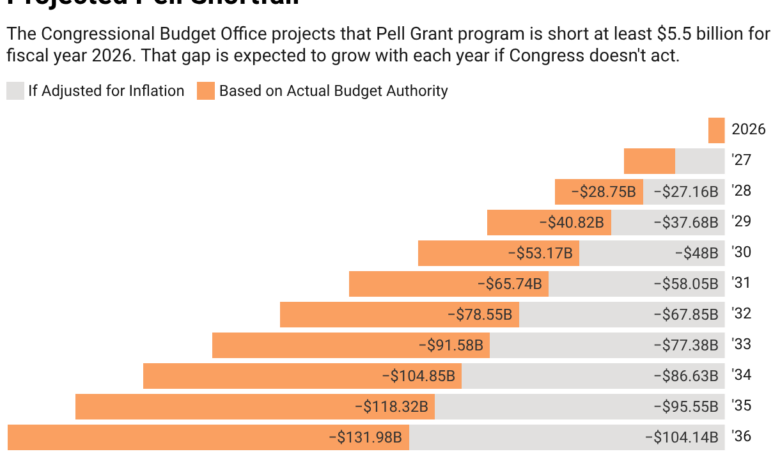
If annual Pell appropriations remain flat at about $22.5 billion and the deficit is left unaddressed, the program will be short by nearly $17 billion in September 2027, according to the CBO; that number could reach as high as $132 billion by 2036.
The Trump administration—which unsuccessfully sought to cut Pell last year—could seek to avert the shortfall by slashing the maximum award per student, restricting the eligibility criteria or making other cuts to the Education Department’s budget. But any cuts to Pell would be devastating, higher education leaders say. In their view, lawmakers must find a way to not only keep existing funds flat but also to cut and redirect dollars from other areas of the budget to put a total of $39.4 billion toward Pell.
“Priority No. 1 is making sure that the program available to the current generation of students continues to be made available to the next at the same levels … We should not go backwards,” said Craig Lindwarm, senior vice president for governmental affairs at the Association of Public and Land-grant Universities.

As a need-based scholarship program proven to promote socioeconomic mobility, Pell has long received overwhelming bipartisan support, and few of the more than half a dozen higher education advocates Inside Higher Ed spoke with fear that Congress will simply slash its federal funds. But how Congress plans to fill the budgetary gap remains uncertain, as does whether it will reform the program to address root causes driving the deficit.
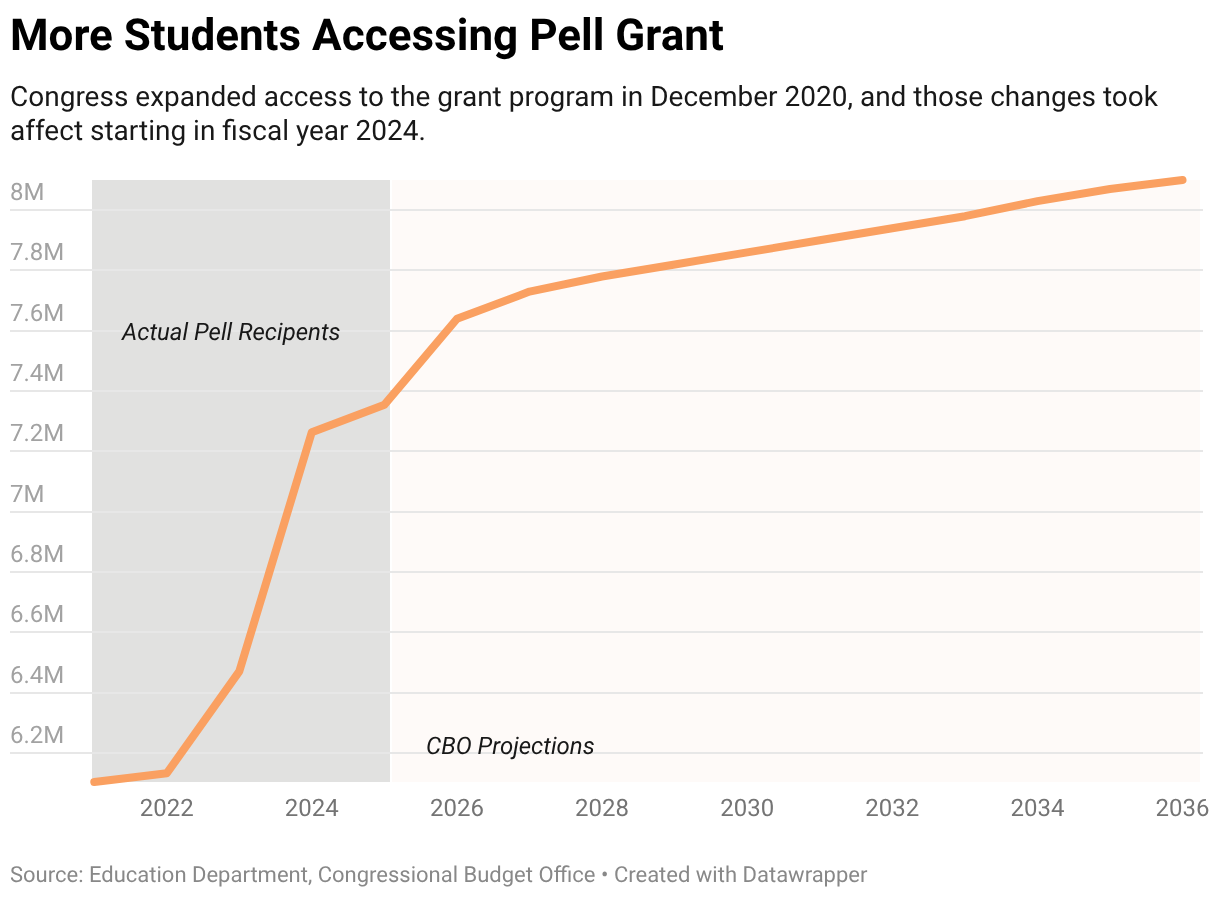
Since 2020, Congress has worked to expand access to the Pell Grant by making the application process simpler and has boosted the maximum award by $1,000—all without providing significantly more funding. Now, the updated program is fully up and running, more students are accessing Pell, costs have skyrocketed and Congress has to find a way to dig itself out of the hole.
“There’s just not a clean, simple answer to that difficult question right now,” Lindwarm said.
However, “at APLU we think this is a highly successful program, and it has been made even more successful due to bipartisan changes that have made it more generous,” he said. “It’s up to policymakers to pay for the changes that they passed.”
Congress has until Sept. 30 to come up with a solution. But given the political tension of a competitive midterm election, other legislative deadlines and the ongoing tensions of Trump’s time in office, experts admit a wealth of other issues are competing for Washington’s attention.
Short-Term Band-Aid
Nearly every source interviewed said that in an ideal world Congress would not only address this year’s funding gap but also implement a long-term solution to the Pell Grant’s funding crisis—all before the fiscal year ends.
But “that is a steep hill to climb,” said Catherine Brown, senior policy director at the National College Attainment Network. Instead, she and others are focused on plugging the $17 billion hole in the Pell program.
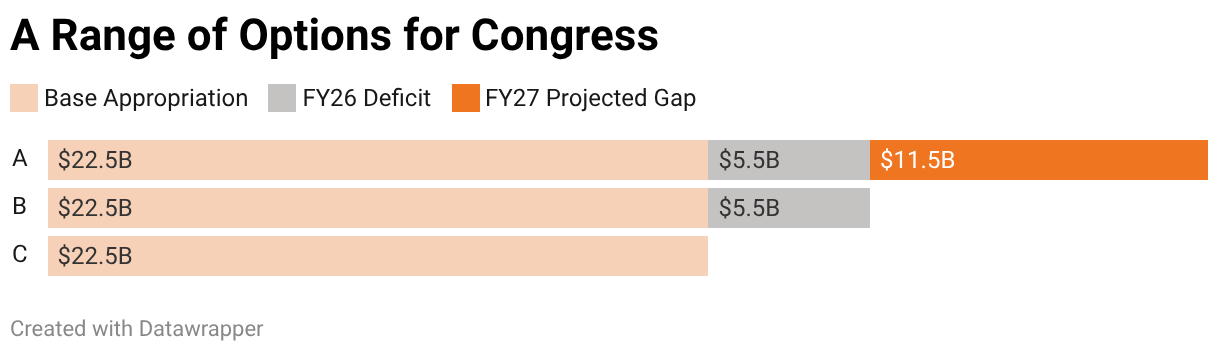
The bill for fiscal year 2027 includes a $5.5 billion deficit for fiscal year 2026 as well as a projected shortfall of $11.5 billion for the next year.
Early in 2025, the CBO predicted the Pell program would be short $10.3 billion by the end of fiscal year 2026—the first shortfall in more than a decade. Congress tried to shore it up with $10.5 billion in one-time funds, but even that injection wasn’t enough.
Despite being a discretionary fund—or a flexible section of the budget that Congress can adjust each year—Pell essentially operates as an entitlement program, a federally funded benefit that any eligible citizen has the legal right to receive. For most entitlement programs, like Medicare or Social Security, the program costs what it costs and is more or less automatically funded. But with Pell, Congress allocates the bulk of its funding on a yearly basis based on the CBO’s projections. So if the office’s predictions are less than what the program actually costs, lawmakers have to find a way to pay back the difference.
For this coming fiscal year, lawmakers could choose to allocate only about $28 billion, which would keep Pell levels flat at $22.5 billion and cover the $5.5 billion deficit from 2026. But if Congress goes with that option and chooses not to also address the projected $11.5 shortfall for 2027, it would likely just be kicking the can down the road as the gap continues to widen.
Most higher ed policy experts hope lawmakers scrounge up about $40 billion total, which would include $22.5 billion for flat funding, $5.5 billion that’s overdue and $11.5 billion for increased demand in the year ahead.
But that’s a hefty amount; last year President Trump sought to cut $12 billion from the Education Department’s overall budget. So finding and reallocating $17 billion won’t be easy.
Most higher ed policy experts would like to see Congress pull funding from other sections of the 12-part budget bill entirely, like Defense, Commerce or Energy. But they recognize some cuts might have to come from directly within the Department of Education or the Departments of Health and Human Services and Labor, which are funded by the same piece of legislation.
“There is certainly money within the federal budget that could be used to fill the shortfall. It was reported that the Department of Defense spent $50 billion in the last week of the last fiscal year, which would fill the shortfall for a few years,” said Will Carroll, a former staffer who oversaw Pell in the Office of Management and Budget. But “to get this done politically, you have to recognize that there’s a little bit of an everybody-chips-in mentality.”
Long-Term Fixes
A few conservative policy experts, however, say the shortfall solution is not spending more, but reducing the cost of Pell altogether. The best way to do that, they add, is limiting who is eligible for the grant.
Adam Kissel, a visiting fellow at the Heritage Foundation, a conservative think tank, wants to see Congress keep Pell funding flat and dole it out based on students’ likelihood of graduating college.
Those who qualify as low-income and have more than a 20 percent chance of graduating college based on their standardized test score should receive the award, and those that fall below that line should not, he said. “If you ask the folks at SAT, the reason it’s called Scholastic Aptitude Test is because it tests your scholastic aptitude.”
In his view, American higher education has become “socialized” and government funding shouldn’t go toward those types of programs—“that’s a waste of time and resources.”
But many say the Pell is just the opposite of a waste. In addition to appropriating the $40 billion needed to protect the program this year, they say, Congress needs to simultaneously develop a long-term solution, though opinions vary on what that fix should be.
Most say that the solution for 2036 is about the same as the solution for 2026, but with a higher price tag. Many groups would like to see Congress allocate about $100 billion in discretionary funding for the next 10 years.
But others want Congress to go further in protecting Pell.
Some, like Michele Zampini, associate vice president of federal policy at the Institute for College Access & Success, want to see Congress turn the entire Pell Grant mandatory. No one Inside Higher Ed spoke with could provide an exact estimate of how much such a major transition like that would cost, but they all agreed it would be well over $100 billion.
To Zampini, it’s well worth it. As long as Congress is basing its budget on projections, the amount of money set aside may not be enough.
“We’re currently in a position where what you will hear appropriators say is ‘Well, we can take money from this program that you really care about and put it into this other one. But they can only move so much money around,” she said. “That’s why pushing Pell out of that entire process and into mandatory spending is the only way to get out of this shortfall that’s projected to happen year after year.”
But making that transition would be a huge lift both politically and financially, most experts say. So while becoming mandatorily funded is the gold standard for any government program, they explained, it would take immense backing to become a reality.
“I do think probably, the simplest thing to do would be to fund the full sum through the mandatory and add that into the underlying cost of the program … So that’s probably our preference,” said Jon Fansmith, senior vice president of government relations at the American Council on Education. “But again, finding $100 billion right now is not a small ask, even given how much Congress is spending. So none of this will be easy.”
At the end of the day, he and others stressed, the chief goal should be ensuring the program remains fully funded.
“I’m not picky,” he added. “However [Congress] can get more funding into the program, we will happily take it.”