AI Tool From Maryland Grads Teaches Case Study Responses
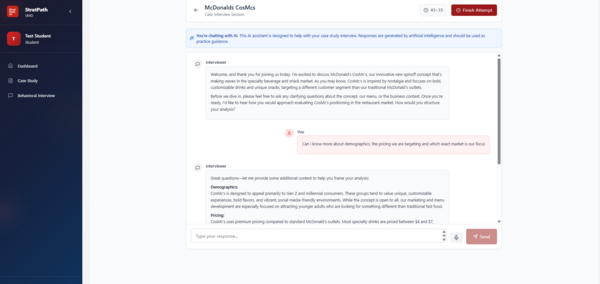
Students can complete faculty-made case study prompts with a generative AI model called STRATPATH.
Nicole Coomber has taught consulting and experiential learning courses at the University of Maryland’s Smith School of Business for years, assigning graduate students take-home case studies that mimic consulting interviews.
But, like many professors in the ChatGPT era, Coomber has found that the assignments no longer challenge her classes, because students simply enter questions into large language models and submit whatever the generative AI model spits out.
“I was discovering that students could pretty much take my assignment, plug it into AI and get a perfect answer without having to go through some of the struggle that we know is part of learning,” she said.
Case studies are a critical part of the interview process for many business students, so ensuring they engage with the exercises and don’t circumvent critical thinking is important to Coomber. But rather than create a new low-tech assignment, Coomber partnered with a group of master’s-level students to make an AI tool to act as a case interviewer.
The result is STRATPATH, a generative AI tool that delivers faculty-created case studies to assess and provide real-time feedback to business students. The tool both connects students’ learning to real-world scenarios and provides career-readiness skills, prepping students for interviews after graduation.
How it works: STRATPATH was developed by six recent UMD business school graduates: Deep Dalsaniya, Anna Huertazuela, Aditya Kamath, Aromal Nair, Krishang Parakh and Venkatesh Shirbhate. The team first assembled to participate in a case competition for M.B.A. students in 2024 and then returned to the university after graduation to launch STRATPATH, using funds allocated by the dean.
“It was a bit of, ‘Hey, these are really talented students, the job market is really hard, they could use a soft landing to keep up with their job search,’” Coomber said. “It’s turned into something much more; we’ve built something that’s really incredible.”

Students can chat with STRATPATH or respond with audio to the faculty-developed case study.
To set up the tool, professors provide the case-study story they want the student to answer, a rubric or feedback form, and some examples of ideal answers, Dalsaniya said. Based on the input, STRATPATH facilitates prompts via audio or text, engaging the student in a conversation.
“Students are getting prepared for thinking spontaneously and building their critical thinking abilities over all,” Dalsaniya said.
STRATPATH relies on a large language model with additional boundaries set by developers to reduce the odds that the AI hallucinates, accepts incorrect information or provides overly complimentary feedback. It also investigates student responses to ensure that they aren’t cheating using outside sources.
“It doesn’t say, ‘Deep, you’re so smart, that’s right!’” Coomber explained. “It’s like, ‘How did you get there?’ So even if the students are typing into ChatGPT, then putting that answer into our platform, our platform will go, ‘How did you get there?’”
The platform also doesn’t allow for copying and pasting responses, so if a student is sidebarring with ChatGPT while responding to STRATPATH, they have to at least transcribe responses (and at a reasonably human words-per-minute rate), which will hopefully produce learning in some capacity, Dalsaniya said.
“Our main focus is whether their critical thinking abilities are increasing or not, and it does even if they are cheating,” he said.
The impact: STRATPATH provides instant grading and real-time personalized feedback, saving faculty time and helping students adjust faster.
It used to take Coomber hours to go over student assignments, which could hinder learning due to the long lag time between assignment and feedback. Now she can spend more time conducting face-to-face learning or holding office hours.
Anecdotal feedback from students so far indicates they feel better prepared to tackle interviews, and they’ve appreciated the assessments from the tool, which identifies both where they’re excelling and areas where they could improve.
What’s next: Coomber and her team are looking to identify other campus stakeholders who might have a use case for STRATPATH. One option is to work alongside the career center to deliver behavioral interview prompts. Many interviewers require applicants to use the STAR method—situation, task, action and result—to respond to questions and use it to assess talent, and STRATPATH could be one forum for students to practice these questions.
Dalsaniya and the development team are also investigating ways to feed STRATPATH additional resources from faculty to provide a richer evaluation of student responses to case studies.
“Case-based learning has no right answer—all answers can be right,” Dalsaniya said. “What we are trying to focus on is how we can integrate all the class materials of the professor, including their slides, their video lectures, within the feedback so that the student can see the feedback and reference those slide numbers or chapters or video transcripts.”
The team is also looking for additional funding sources to scale and possibly license the tool for outside groups.