Branded Content That Converts: Turning Industry Insights Into Sales Opportunities
What Is Branded Content? (And What Isn’t)
The simplest definition of branded content is material produced by an advertiser to associate their brand with specific content and build awareness. However, how is it distinguished from other types of paid content partnerships? The core difference is that branded content marketing isn’t driven by sales goals but by offering value and connecting on a deeper level with audiences. By focusing on the interests, challenges, and pain points of your core audience, you build relevancy and emotional connections. This way, you improve your brand image and establish yourself as an industry savant, boosting people’s trust in you.
You don’t even have to include links back to your website. The more interesting and valuable your content is, the more likely people are to search for you after consuming your content. You can’t expect to get more customers directly from that content, though. This might happen over the course of time and after you’ve gained people’s trust.
But what is the issue with branded content? People have different takes on what it is or should be. However, everyone can agree on one thing: branded content that converts isn’t pushy. It provides people with relevant and valuable information and lets knowledge do the rest.
Are you ready to create branded content that drives sales?
Choose eLearning Industry to help you bring your vision to life!
In This Guide, You Will Find…
Why Does It Work Better Than Traditional Advertising?
Statistics show that branded content drives 86% brand recall compared to traditional advertising that drives 65%. That’s maybe because traditional advertising initiatives usually focus on promoting a specific product or service, stating its features, benefits, and potential outcomes. It’s very direct in its mission and offers as many product details as possible. However, traditional ads may have limited interest, as only a small core audience might actually be interested in purchasing or trying out your demo.
On the other hand, branded content has a wider focus. You offer information and insights that appeal to more people, whether they might want to buy something or not. For example, if you are an LMS vendor and want to promote your tool’s upskilling and reskilling features, you may create an article that appeals to both employees and employers.
Why would a company use ads? Probably to generate new leads and expand its reach to those interested in buying something now. That’s why online ads usually include CTA buttons with links directing users to a specific page where they can purchase products.
However, a branded content strategy aims to construct a powerful brand image and help you increase your revenue over time. It’s not a “now” solution to closing deals, but a strategy to make others trust you and view you as a thought leader. Your goal is to increase your content’s visibility and shareability.
You can’t always predict how someone will consume your ad because they are controlled by third-party platforms. For example, your social media ad may appear as a pop-up or in the sidebar. Also, you can’t know who will see your ad. The third-party platform will make this decision based on your settings. If you’d like more predictable, niche, and audience-specific ad placements, you can go with eLearning Industry’s banner ads that offer specific placement.
On the contrary, branded materials are located on specific websites, and anyone can access them at any time of the day; all they need is an internet connection. You can also promote your content on social media to expand its reach.
How many times have you shared an ad with someone else or publicly on your profiles? We guess almost none. This means that traditional advertisements rarely become viral or at least popular.
On the other hand, content like branded research reports can easily go viral and appeal to wide audiences. When something offers value, people are more likely to share it with their peers and engage in the comments.
Examples Of Branded Content
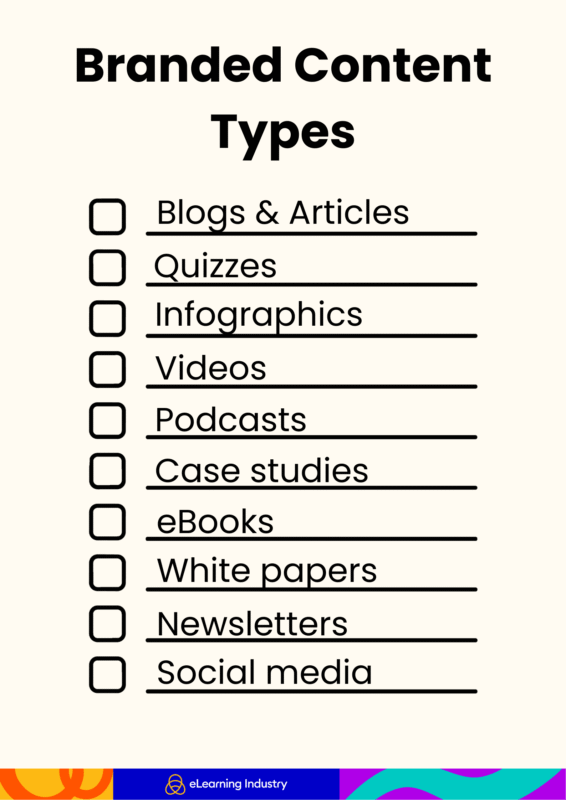
These are the backbone of most branded content strategies. They educate readers, explore industry trends, and share insights that position your brand as a thought leader. When done well, they provide genuine value and spark curiosity about your expertise without a single sales pitch.
Interactive content, like quizzes, adds a layer of engagement that static formats can’t match. They invite participation, helping your audience learn something new about themselves or their business needs while subtly highlighting your brand’s relevance.
Infographics distill complex data into a visually appealing, easy-to-digest format. They’re perfect for busy professionals who want to understand a topic at a glance.
Videos help you reach your B2B storytelling goals and, therefore, connect emotionally with your audience. Whether it’s a short explainer or a thought leadership interview, well-crafted videos make your brand more human and memorable. Webinar marketing is also effective in creating deeper bonds with your buyers.
Podcast marketing gives your brand a voice. It allows for deeper storytelling, nuanced discussion, and authenticity that builds loyalty over time. People listen because they trust your perspective, not because you’re trying to sell them something.
Case studies turn customer success stories into proof of your expertise. They show how your brand solves real problems, offering tangible evidence of impact while keeping the focus on the client’s journey, not just your product.
eBooks offer an in-depth exploration of topics your audience cares about. They demonstrate thought leadership and provide actionable insights, giving readers something of lasting value that strengthens your authority.
White papers are the academic side of branded content. They are research-driven, data-backed, and the bottom-of-funnel content that decision-makers need. They’re designed to inform strategic thinking and position your brand as an expert source in your field.
Email marketing, and specifically newsletters, keeps your brand top of mind by offering regular, curated insights. When focused on delivering value rather than promotions, it becomes a trusted resource your audience actually looks forward to reading.
Social media content extends your brand’s voice into everyday conversations. It’s where you share ideas, celebrate wins, and build relationships in real time. The key is consistency and authenticity, showing up with value, not just visibility.
The Branded Content → Sales Opportunity Framework
Step 1: Identify Insight Themes
The first step in turning branded content into sales opportunities is to uncover the insights that matter most to your audience. Start by analyzing their pain points, understanding market shifts, and identifying skills gaps, while considering HR and L&D priorities to see where challenges intersect with Learning and Development. These insight themes form the foundation of a full-funnel content strategy, ensuring everything you create resonates deeply with your audience. By focusing on real challenges rather than assumptions, your content marketing for B2B becomes relevant, valuable, and positioned to build trust from the very first interaction.
Step 2: Build Insight Assets
Once insight themes are clear, it’s time to translate them into tangible assets. Research reports, benchmark data, and industry surveys provide credibility and authority, forming the core of your research and insights. Trend guides and framework-based articles help contextualize the data and offer actionable takeaways. These assets are not just valuable information, though. They’re the building blocks for content that educates and informs. An industry insights report, for example, positions your brand as a trusted advisor rather than a vendor.
Step 3: Turn Insights Into Branded Content Formats
Insight assets reach their full potential when they are transformed into formats your audience engages with. Data visualizations make complex information easy to digest, while CEO commentary and case studies give a human and practical perspective. Templates, checklists, and playbooks translate insights into actionable tools, making it simple for professionals to apply your expertise in their day-to-day work. By matching insights to formats that deliver usefulness and clarity, you turn your research into content marketing ideas that resonate throughout the B2B buyer journey.
Step 4: Distribute Across High-Trust Ecosystems
Content is only as effective as its distribution. A well-planned content distribution strategy ensures your insight-driven branded content reaches ecosystems your audience already trusts, from top-of-funnel spaces like eLearning Industry to targeted email nurture campaigns. Incorporating insights into sales decks further supports meaningful conversations with prospects. This multi-channel approach maximizes visibility and engagement while maintaining your brand’s authority and reliability. By strategically distributing content where your audience is already active, you turn valuable insights into lasting connections.
Step 5: Enable Sales With Insight-Driven Conversations
Scripts, talking points, and ROI data help sales professionals articulate the value of your solutions with confidence. Personalized outreach that references audience-specific challenges makes interactions feel relevant rather than transactional. By embedding insights into the sales process, your team can follow a content-to-pipeline framework, turning branded content into a bridge between awareness and decision-making. This approach sparks meaningful dialogue, demonstrates expertise, and positions your solutions as natural responses to client needs, supporting trust-based engagement that drives results.
Step 6: Convert Demand Into Pipeline
The final step is turning the interest your content generates into sales opportunities. Webinars can feed demo requests, toolkits function as lead magnets, and research reports can prompt comparison or evaluation requests. By connecting content consumption to clear next steps, you create a seamless path from insight to action. Integrating this approach into demand generation campaigns allows your team to facilitate engagement naturally. Over time, this builds a pipeline of leads who are already familiar with and trusting of your brand, driving measurable content-sourced revenue.
How To Turn Research Into A Branded Content Engine
-
Extract Patterns And Trends
The first step in turning research into a branded content engine is spotting patterns and trends that matter. Look for recurring challenges, emerging market shifts, and gaps in skills or knowledge. These patterns form the foundation of your brand’s perspective, helping you create content that actually resonates.
It’s not only about the data you extract, but also about telling a story your audience can relate to. By creating clear takeaways, every blog, infographic, or report you create becomes content that drives sales while remaining purposeful and engaging.
-
Build A Category Leadership Narrative
Once you’ve identified the trends, it’s time to turn them into a story that positions your brand as a category leader. This isn’t about self-promotion, but about showing that your brand understands the challenges and opportunities shaping your industry. For example, if your research shows a growing skills gap in digital learning design, you can frame that insight as a narrative about how organizations must adapt their L&D programs to stay competitive.
Your content then becomes more than just plain information, as it serves as a reference point for understanding change, identifying opportunities, and informing decisions about training strategy. Over time, this narrative builds authority, trust, and positions your brand as the voice others in eLearning look to for guidance.
-
Package The Content For Multiple Personas
Insights are only valuable if they reach the right people in the right way. Different roles have different priorities: CMOs want benchmarks and trends, L&D managers need actionable best practices, and CEOs care about strategy. Packaging content for each persona ensures relevance and engagement.
In SaaS content marketing, this approach is key, as one report can turn into a webinar for managers, a slide deck for executives, or a case study for decision-makers. It can also feed sales enablement content like talking points or scripts. When content feels tailored, your brand becomes a trusted resource across multiple levels, helping every stakeholder see the value in your research and the solutions you offer.
-
Connect Every Insight To A Commercial Outcome
Research is powerful, but it becomes even more valuable when it drives action. Every insight should connect to a problem your audience faces, a solution your brand provides, and a next step that guides engagement. That might mean moving someone from reading a report to signing up for a webinar, downloading a toolkit, or requesting a demo.
By linking insights to tangible outcomes, your content moves beyond awareness and becomes part of a meaningful B2B content experience. It helps audiences understand not just what’s happening in the market, but why it matters to them, and how your brand can help solve their challenges.
One of the smartest ways to get more value from research is to reuse it across multiple formats and channels. A single report can become dozens of articles, social posts, webinars, gated content, or even sales enablement materials like talking points and scripts. Reusing doesn’t mean recycling lazily. It means adapting insights to different audiences and formats so they remain useful and engaging.
Sharing material on trusted niche content syndication platforms, like eLearning Industry, amplifies reach and reinforces key messages while integrating these efforts into your broader B2B content marketing strategy. This way, every insight becomes a small engine driving visibility, engagement, and influence across the audience journey.
Effective Distribution Channels For Your Content
1. Owned Channels
Every content marketing strategy starts by sharing material on owned channels. What are they? Basically, it’s every channel you own, including your website, apps, newsletters, and social media accounts. Your website specifically is the place where you house all your content, landing pages, and SEO to establish thought leadership and strengthen your organic visibility. It’s where you publish everything you produce, including eBooks, articles, templates, and webinars.
You also use your website to direct people to the rest of your owned media. For example, you may create a banner ad to encourage visitors to sign up for your newsletter or to follow you on social media.
2. Earned Channels
On the other hand, earned media refers to other people talking about your brand online. For example, a podcast may reference your brand as a valuable industry vendor. Or a buyer might visit a software review platform and leave a review regarding their experience. While you can’t always control what is said about your brand online, you can definitely use your magic touch to generate positive buzz. For instance, you may contact a podcast presenter and propose a collaboration.
Additionally, you can create branded social media posts with niche-specific brands or figures. And how about incentivizing your buyers to leave positive reviews on various websites, including your Google page?
3. Paid Channels
Paid media includes social media ads, native ads, banner ads, email marketing placements, PPC ads, search engine advertising, and basically everything you pay for to gain exposure. For example, you can create a PPC directory listing on an industry-specific publication and upgrade your listing to make it appear at the top of your chosen list. On top of that, you create a banner ad on the same publication that you know attracts people who fit your buyer personas.
Social media platforms, like Instagram and Facebook, offer supreme targeting so you can appeal to the audience you need. If you want to promote a specific product or service, you can also create a search engine ad to have your landing page appear at the top of the search results pages.
How Vendors Turn Insights Into Leads Using eLearning Industry
Many vendors are turning insights into qualified leads by partnering with trusted industry platforms like eLearning Industry. By publishing branded content such as insight reports, they position themselves as credible voices within the learning space while offering audiences valuable, data-backed information. Templates, checklists, and other practical tools extend that research into actionable takeaways that L&D professionals can immediately use.
Vendors can also run targeted lead gen campaigns built around their insights, turning engagement into measurable results. Turning research into gated content supports a full-funnel content strategy. But let’s go beyond lead generation. Publishing on a respected domain like eLearning Industry enhances editorial credibility, strengthens brand perception, and boosts visibility in AI Overviews and search results, helping you get discovered by the right audience at every stage of the journey.
Ready to stand distributing your content?
Distribute your next insight report on eLearning Industry to reach 1M+ targeted L&D and HR buyers
Key Takeaway
Branded content works because it creates genuine connections built on insight, credibility, and value, not sales pressure. It’s what separates brands people trust from those they scroll past. Whether you’re publishing research, creating templates, or running campaigns, the goal is always the same: to share knowledge that positions your brand as an authority worth listening to.
Many organizations partner with content marketing agencies to scale their efforts, ensuring every asset aligns with audience needs and drives meaningful engagement. When executed thoughtfully, branded content transforms into thought leadership content that informs, inspires, and influences. The result is a seamless B2B content experience that attracts attention, builds loyalty, and naturally leads audiences from awareness to action, all while strengthening your brand’s position as a true industry leader.
FAQ
Branded content in the B2B world is storytelling or informational content that reflects a company’s brand values and expertise without overtly selling. It aims to educate, inspire, or entertain other businesses while subtly reinforcing the brand’s identity and credibility.
B2B branded content builds trust, thought leadership, and long-term relationships with potential clients. It helps companies move beyond product features and connect through shared values, insights, and expertise, making their brand more memorable and trustworthy.
Unlike traditional advertising, which focuses on direct promotion, branded content is about creating value for the audience first. It differs from generic content marketing by maintaining a stronger link to brand identity, ensuring the tone, visuals, and message reflect the company’s personality and purpose.
Effective B2B branded content often includes thought leadership articles, case studies, white papers, webinars, and videos that highlight industry expertise. Many companies also use branded sales decks, research reports, and podcasts to deliver consistent, high-value messages across touchpoints.
Successful branded content is consistent, audience-focused, and authentic. It addresses real business challenges and showcases expertise rather than pushing products. Companies should avoid being overly promotional, inconsistent in tone, or creating content without a clear strategic purpose.
ROI for branded content can be tracked through engagement metrics like time on page or video watch time, lead quality, and brand perception over time. Since branded content is about trust and long-term impact, measuring awareness, credibility, and sales influence gives a complete view of success.