Criminology Professor Spills His “Love Is Blind” Story
It’s been a whirlwind few weeks for Ohio State University professor Vic St. John. A year has passed since he took a semester off to film the most recent season of Netflix’s Love Is Blind, and he has kept a low profile while the show aired over the last couple of months. With Wednesday’s cast reunion said and done, the criminology professor is ready to shout his success.

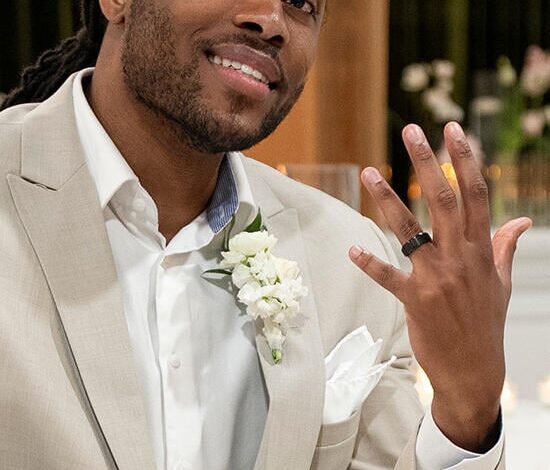
Ohio State’s Vic St. John shows off his wedding ring.
St. John, 34 and up for tenure next year, joined Season 10 of Love Is Blind, which features 16 men and 16 women from Ohio who date over a period of 10 days, separated by an opaque wall. If they fall in love, they have the opportunity to get engaged before ever laying eyes on each other. And, once engaged, they must meet each other’s families and friends and learn to live together before deciding whether to say “I do.” Spoiler alert: It worked for St. John. He and his wife, Christine, a speech language pathologist, have been married for almost a year.
With its unending teaching, research, mentorship and faculty governance work, academia didn’t make a great dating pool, according to St. John. But his experience on a dating show has opened doors for him in academia—professors across the country are reaching out with messages of support and requests to collaborate, he said.
Inside Higher Ed sat down with St. John to hear about his experience on the show as a professor, what he took away from it and how it’s impacted his academic career so far.
Inside Higher Ed spoke with St. John over Zoom. This interview has been edited for length and clarity, and contains spoilers for Love Is Blind Season 10.
Q: So, Vic, you’re a tenure-track, successful professor at a major university. I don’t know anything about the Ohio dating pool, but why go on Love Is Blind in the first place?
A: Dating while being in academia is difficult in a lot of ways, especially with my working style—I tend to go full throttle, for lack of a better word. So the full-on teaching, mentoring students, the research, the service attached to it—it just makes your day very busy relatively quickly. Coupled with that, I definitely hold very specific boundaries in the academic setting, so there isn’t really much opportunity to meet people or date.
A friend of mine was like, “Hey, this show is coming to your town. You should take a look at it, I know what your dating life has been like.” And I took a look at it and I was like, “No, there’s no way I can do this.” I have a whole career that I care about. I’m a very private individual, and to take a risk to enter this experiment—who knows what I’ll encounter. And then it also goes out to the public. But when I sat back and looked at the questionnaire associated with the experience, there were some pretty thought-provoking questions. I think I was almost weirdly excited to just respond to the questions and have that cathartic experience of really digging deeply and introspectively into my dating life and the romantic side of me … And before I knew it, I’d answered all those questions. So I hit submit.
Not too long after, I was watching a sermon on TV because I couldn’t go into church that day. It keeps me grounded, keeps me centered. Ping—my phone goes off, and it’s a text message from someone who does the screening and the casting, and they’re like, “Hey, I’d like to talk more to you about an opportunity” … So I took the call, and before I knew it, things kind of just snowballed. I was in the pods.
Q: Well, it definitely worked out for you—congratulations on getting married! Have you watched the show at all since it aired?
A: Yes. Interestingly enough, when the show is airing, Christine and I have to stay hidden, out of sight, like a secret husband and wife. But we live together, right? We’re married while we’re watching ourselves meet on TV.
Q: Is there anything about your experience that was not included in the final edit that you wish was aired?
A: Yeah, I would say some of the lighter sides to Christine and I. A lot of the edits show our more serious conversations around dating—our past experiences with our families, conversations about what a future family would look like and those sorts of things. They were meaningful conversations and we had a lot of those, actually. You have to. You’re going to make a big decision, right? But then there were also some lighthearted, fun times that her and I had that weren’t necessarily captured. Whether it was sharing music in the pods, jamming out or just some of my corny jokes and her quirkiness—those aspects of things, I don’t know we really got to see much of.
Q: I did notice that they sort of speed-ran your whole story in the first episode, and that’s all we really got from you guys in the pods.
A: So, fun fact: If you’re going to propose, they all have to be on the same day. Each day there are rounds of dates, and those lists of who you are dating get smaller and smaller, and [the dates] can go for several hours. Eventually you start doing night and day dating for six hours on end, taking breaks at your cadence, so you really have a lot of time to just talk. There are little things in between—sharing music, experiences, jokes—but the way the final product comes out can look in a number of ways. So it just happens that in episode one, it shows us getting [engaged].
Q: That’s good to know, because I was wondering if you were just then sitting in the men’s quarters like, “All right, I’m engaged,” and watching the rest of the guys still go through it. The camaraderie in both the men’s and women’s quarters always reminds me of a college dorm setting. Did it feel like being back in undergrad to you?
A: Oh, man, I wouldn’t use “undergrad” as a descriptor. There are people going through the same shared experience in different ways. We don’t talk about who we’re dating or getting to know, per se, and, if I can be honest, the way that some folks showed up on the men’s side looks different from what I ended up seeing on-screen, where there were sides of the men I didn’t know existed. So I would say it was pretty cordial and chill. There are a few of the guys that I really connected with. One was Haramol Gill—he’s an emergency room doctor out here in Ohio as well—and we just hit it off with our worldviews on life. And Jordan Faeth is another person on the guys’ side that I really hit it off with. We connected more so over our faith.
Q: It’s great that you are able to leave with some new friends, too. A nice bonus.
A: It is, and it was a good reprieve. In academia, we focus on academics—we should, right? But that professor in front of the classroom is a whole person outside of our careers, and there are other aspects of and dimensions to us. It was cool to be able to tap into that by way of this experiment.
Q: I did notice—and I know a lot of viewers have noticed—that political discussions are often left out of the final edit. I know your research [is] on criminology and criminal justice, which is closely tied to politics in many ways. Did you want to talk about that more on the show? Did you talk about it, and we just didn’t get to see that?
A: Yeah, politics were definitely discussed in those pods. I don’t know what the reasons were for what got aired or didn’t get aired. We don’t have any say in that, but we definitely had those conversations. Again, you’re about to potentially propose to someone, and then later on to see if you want to say yes at the altar, so you’re asking all of those heavy-hitting questions. That was happening, at least in my conversations, and I’m pretty sure in a lot of other guys’ conversations.
Q: I also noticed that you never mentioned Ohio State by name. That was on purpose, right?
A: Yes. I never mentioned Ohio State on purpose while I was there. I also made sure I followed all the ethical rules necessary to get into an experiment like this. Part of it is making sure to go through the university legal team, to make sure you’re not receiving any payment during this time, any benefits, no health care, no retirement. It’s a full-on unpaid, off-duty activity. So I went through all those channels, and then part of it was … I just was not going to say Ohio State’s name while I’m in the experiment. It’s not necessary.
Q: The participants and the hosts in the show always refer to it as an experiment, but you’re a researcher: Do you think that’s an appropriate word for what’s going on in the show?
A: I mean, we don’t have a counterfactual at play here. So if we use the term “social experiment” loosely, I would say yes, but because we don’t necessarily have the control group … I’ll say it wouldn’t fall into the gold standard of randomization.
Q: Would you recommend going on the show to other academics?
A: Yeah. I pause there, because I don’t think it’s necessarily the professional component that’s too risky, but I think it’s more so who you are as a person. Regardless of if you’re in academia, or if you’re a law enforcement officer, or you are a nurse or whatever your career is—if your personality is a certain way, then maybe you shouldn’t embark on an experiment like that. That’s kind of the nice way to put it. But if you’re open and you can truly see finding a potential partner, then I think this specific show was set up and designed pretty well.
Q: How have your students reacted to the show? I assume they have been watching.
A: The students have been super supportive. The hype was larger when it first started—I had one student raise their hand in class and say, “Hey, I saw you on my [TikTok] For You page,” and brought up the elephant in the room. So I quickly took maybe 30 seconds of class time and said, “Yes, that is me, but we’re not going to talk about that in the middle of class.” But they’ve been super supportive.
Q: What about colleagues? Have they talked to you about it?
A: Yeah, my colleagues are super excited. Within the university and even outside the university, academics have reached out to say, “Hey, we like how you represented us. It was good to see the whole person. We study, we do research, we mentor, we teach, we’re serious about our business and we also have this other side to us. So it was cool to see the whole professor.” And then some folks confused it with other shows.
Q: Like Love Island?
A: No shots to those shows, but they’re different kinds of setups. Love Is Blind is unscripted. Who you are when you show up is who you are, and you’re looking for a forever partner.
Something interesting that’s happened, too, is that I’ve been getting outreach from academics not only in support, but also about collaborating on research. They’re like, “Hey, can we work on something together? Or do something together with your skill set and your expertise?” And I’m like, “Sure, let’s talk.” So it’s opened doors for other connections to be made.
Q: OK, last question for you, Vic: Is love truly blind?
A: I believe so. The connection that I made with Christine before I saw her was so true, so real. It was a visceral feeling, and it was just a wall between us. All I have is the voice.
Once the dates are done, you’re lounging with the guys, or sometimes you go back to the room to sleep, and I just couldn’t help but continue thinking about her, the connection we’re building, the curiosity I had about other aspects of her life, learning about her family, her quirks, all these things. And it was really cool to have that devoted time where I knew I was in love with her before I went down on one knee. It did not matter who came through those doors. It would not have mattered.