From $1M to $10M ARR: Lessons from Tech Companies
Lessons From Winning Learning Tech Companies
Running a business that aims to reach $1M in Annual Recurring Revenue (ARR) proves demand. On a bigger scale, reaching $10M in ARR proves scalability.
It is important to note that the journey from $1M to $10M ARR is not just a bigger version of early growth. It is an overall structural shift operationally, commercially, and organizationally.
In the L&D market, the majority of learning tech companies stall between $2M and $5M ARR. This means that they have customers, traction, and references. However, they lack the systems required for durable revenue acceleration.
In this article, we not only cover the startup basics. We dive into a revenue-stage-specific analysis of how fast-scaling learning tech companies like LMS vendors, HR tech platforms, and B2B SaaS training providers successfully crossed the hard $10M ARR milestone.
In general, scaling from $1M to $10M ARR requires operational discipline, repeatable go-to-market systems, and a sharp positioning strategy, not simply more sales effort.
Some common facts to establish before we go further:
- $1M ARR validates product-market fit; $10M ARR requires scalable systems.
- Fast-scaling learning tech companies prioritize positioning, retention, and repeatable GTM.
- Growth plateaus often result from weak differentiation and inefficient acquisition.
- Sustainable ARR expansion depends on retention, expansion, and operational maturity.
TL;DR
- $1M ARR validates product-market fit; $10M ARR requires scalable systems.
- Fast-scaling learning tech companies prioritize positioning, retention, and repeatable GTM.
- Growth plateaus often result from weak differentiation and inefficient acquisition.
- Sustainable ARR expansion depends on retention, expansion, and operational maturity.
Accelerate Your Path To $10M ARR
eLearning
In This Guide, You Will Find…
What Changes Between $1M And $10M ARR
The decisive shift to the next milestone of $10M ARR is not about “working harder” but working smarter. In company terms, it is about building repeatable infrastructure that will assist long-term scalability.
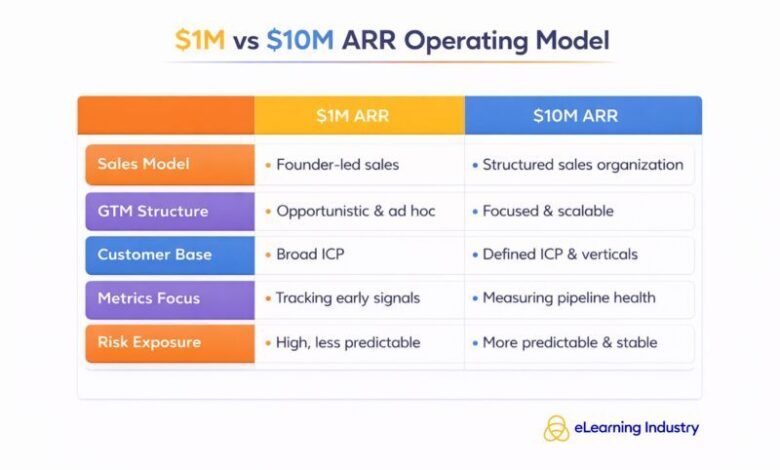
At $1M ARR, companies showcase:
- Founder-led sales
- Opportunistic deals
- Broad ideal customer profile (ICP)
- Flexible pricing
- Reactive marketing
- Revenue driven by hustle
Growth is not something that happens overnight. Growth happens through relationships, referrals, and momentum. Always remember that it works until it doesn’t.
At $10M ARR, companies showcase:
- Defined ICP
- Vertical focus
- Structured sales organization
- Predictable pipeline coverage
- Defined metrics discipline
- Formal revenue leadership
For the companies that have reached this milestone, revenue becomes a system, not a personality.
Positioning Becomes The Growth Multiplier
Solid positioning in the market is the critical first step to establishing growth. It is the inflection point of a company’s journey. In short, for a company to reach the milestone, it has to make its positioning the growth multiplier.
In the current state of the market, fast-scaling learning tech companies do not grow faster because they add features to their products. On the contrary, they achieve rapid growth because they sharpen their positioning in the market.
What Changes In Positioning
Multiple things change within a company when it comes to positioning. Here we have two lists. One for the early stage and one for the scaling stage.
At the early stage:
“We are a flexible LMS for everyone.”
“We serve all industries.”
At the scaling stage:
- Narrow ICP
- Defined vertical narrative
- Clear business outcome
- One primary buyer persona
Now you understand why growth accelerates when positioning sharpens. As you grow, your messages become more targeted and specific. This leads to:
- Sales cycles shorten
- CAC decreases
- Win rates improve
- Enterprise trust increases
That is the main difference between fast-scaling learning tech companies and stalled ones. The first ones stop selling features; they sell outcomes:
- Faster compliance deployment
- Improved onboarding speed
- Measurable workforce upskilling
- Enterprise-ready governance
Repeatable Go-To-Market Systems
For a learning tech company to grow, it needs to create a repeatable go-to-market strategy that it will follow during its scaling process. The importance of this system can be seen in the difference between the $1M ARR and $10M ARR milestones. In short:
At $1M ARR, growth can be chaotic.
At $10M ARR, chaos kills momentum.
Fast-scaling SaaS companies that understand this difference and aim to reach the next milestone need to implement the following.
1. Defined Acquisition Channels
The first and most important step is to define their acquisition channels. This will ensure that they invest in the right things that improve ROI.
In a nutshell, they identify:
- Which channels produce SQLs
- Which produce enterprise buyers
- Which scale predictably
The strategy here is to find what works and double their investment on it. This will ensure scale.
2. Predictable Pipeline Math
Following the acquisition channels, SaaS companies need to track revenue correctly to see if their investments pay off. They can achieve this by creating predictable pipeline math.
In a nutshell, revenue leaders track:
- Required pipeline coverage (3–5x)
- Conversion rates by stage
- Average deal size trends
- Sales cycle length
With solid, predictable pipeline math, growth becomes forecastable.
3. Marketing And Sales Alignment
In many scenarios, marketing and sales are interconnected. Marketing departments generate demand, while one of the sales goals is to capture it and transform it into revenue. In business terms:
- Marketing generates qualified demand
- Sales executes against defined ICP
- Customer success protects expansion
Therefore, it is vital to have an alignment between the two departments to ensure the smooth process of transforming demand generation into lead capture.
4. Data-Driven Discipline
Solid data tells the truth. Every decision a company makes towards the milestone-reaching process should be based on data. Fast-scaling learning tech companies know the value of data-driven discipline and measure the following:
- Customer acquisition cost
- Lifetime value
- Gross margin
- Net revenue retention
- Expansion revenue rate
All these metrics replace intuition. Having clear revenue targets and measurable outcomes guides scaling discipline.
Retention And Expansion Drive ARR Acceleration
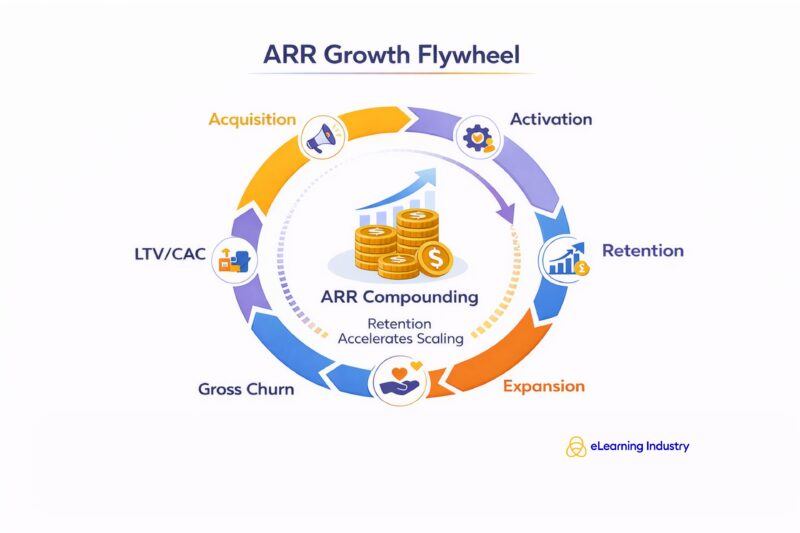
The step between $1M and $10M ARR requires shifts. When it comes to retention and expansion, the biggest shift is this: net revenue retention matters more than new logos.
In short, early growth is acquisition-driven. On the other hand, sustained growth is retention-driven.
What Changes At Scale
Here is what changes at scale. For instance, at $10M ARR:
- Expansion revenue compounds
- ACV increases
- Multi-year contracts become common
- Churn becomes existential
It is important to note that if retention weakens, scaling often collapses.
Metrics That Matter
Metrics are vital if you want to track the right story. Here are some important metrics to keep in mind:
- Gross churn
- Net revenue retention (NRR)
- LTV/CAC
- Expansion revenue rate
- Pipeline coverage ratio
In general, companies that reach $10M ARR often achieve:
- 110–130%+ net revenue retention
- Increasing ACV year over year
- Improving CAC payback periods
In this scenario, ARR acceleration becomes mathematical.
Capital Allocation And Investment Discipline
In capital allocation and investment discipline, the difference between winners and losers in the market is that fast-scaling learning tech companies make disciplined financial decisions.
In fact, fast-scaling learning companies:
- Invest in proven channels
- Avoid premature hiring
- Build infrastructure before operational chaos
- Prioritize leadership hires over junior expansion
It is no wonder that scaling to $10M ARR requires maturity in capital deployment, as revenue acceleration without operational discipline creates fragility.
Spending aggressively on anything that seems like a good investment will not take your company to the next level. On the contrary, the leap from $1M to $10M ARR is fueled by disciplined allocation.
Fast-scaling learning tech companies follow the pattern shown below.
1. They Invest In Proven Channels
When your company reaches $3M in ARR, experimentation decreases. Now, every investment counts.
Instead of spreading budget across:
- Multiple paid channels
- Broad sponsorships
- Unclear partnerships
Fast-scaling learning tech companies double down on:
- Channels with measurable CAC efficiency
- Sources producing enterprise SQLs
- Programs with predictable pipeline contribution
For winning companies, the focus is scaling, not expansion.
2. They Avoid Premature Hiring
There is a common case of stalling between companies because they tend to hire ahead of clarity.
Here are some common examples:
- Expanding sales before refining ICP
- Hiring multiple marketers without a defined GTM model
- Building layers of management without process discipline
On the other side, fast-scaling SaaS leaders hire when:
- Pipeline coverage justifies expansion
- Processes are documented
- Roles are clearly defined
For winning companies, headcount growth follows revenue logic.
3. They Fund Infrastructure Before Chaos
Being proactive always pays off. Especially when the stakes are high. In the space between $5M–$8M ARR, operational cracks often appear:
- CRM inconsistencies
- Forecasting gaps
- Contract management inefficiencies
- Customer success overload
Companies that reach $10M ARR invest in:
- RevOps capability
- Financial reporting discipline
- Implementation systems
- Customer onboarding standardization
The key takeaway here is that infrastructure reduces fragility.
4. They Prioritize Leadership Hires
Companies at higher stages often prioritize leadership hires. Hence, the most important hires between $3M–$7M ARR are:
- Revenue leadership (CRO or VP Sales)
- Customer success leadership
- Product leadership
At this stage, leadership depth matters more than tactical energy. Therefore, it is safe to say that execution quality determines scalability.
Leadership Evolution: From Founder To Executive Team
Another differentiating factor is visible in the leadership of each company. To define, in a company at $1M ARR, the founder drives sales, product, hiring, and messaging. However, in companies at $10M ARR, the founder builds systems and delegates authority.
Some scaling demands are:
- Defined accountability
- Strong second-layer leadership
- Clear org structure
- Revenue ownership clarity
It is vital to know that $10M ARR is not only a revenue milestone. It is an organizational milestone.
Founders do not stay stable while their companies evolve. Instead, they evolve with them.
Therefore, at $1M ARR, the founder is the engine. However, at $10M ARR, the founder becomes the architect. This solid transition is uncomfortable but necessary.
Delegation Becomes Mandatory
When a company scales, micromanagement has to go. Everyone in the engine should have their own authority over their projects. In short, scaling requires:
- Revenue ownership beyond the founder
- Clear accountability structures
- Defined KPI ownership
- Decision-making frameworks
Micromanagement suffocates scale and damages revenue.
Organizational Clarity
Organizational clarity is also vital for the scaling engine to work at its maximum. Fast-scaling learning tech companies define:
- Clear reporting lines
- Sales territories
- Vertical ownership
- Performance expectations
Here, ambiguity slows velocity while structure increases speed.
Building A Strong Second Layer
When the stakes are high, having a backup is important. That is why winning companies often invest in building a strong second layer.
Companies that plateau often lack:
- Empowered managers
- Revenue accountability
- Succession depth
Companies that cross $10M ARR typically build:
- A strong VP layer
- Dedicated revenue operations
- Defined cross-functional alignment
$10M ARR is an organizational milestone, not just a financial one.
Common Growth Plateaus Between $2M–$5M ARR
Here is the most difficult step, in which most learning tech companies stall. In this phase, revenue exists, customers are satisfied, and growth feels possible. However, acceleration slows.
Specifically, the $2M–$5M ARR range is the most dangerous stage in B2B SaaS growth because:
- Complexity increases
- Expectations rise
- Operational gaps get exposed
- Revenue becomes harder to multiply
Let’s break down the most common structural plateaus.
1. Broad Targeting Dilutes Momentum
In this phase, many fast-growing LMS vendors and HR tech vendors try to serve:
- Corporate L&D
- Compliance
- Healthcare
- Manufacturing
- SMB
- Enterprise
- Global
- Local
This long breadth weakens:
- Messaging clarity
- Sales precision
- Competitive differentiation
Therefore, when positioning is vague, growth flattens.
The key takeaway here is that fast-scaling tech companies narrow their ICP. However, plateaued companies expand it.
2. Inefficient Customer Acquisition
Early growth often comes from:
- Founder relationships
- Referrals
- Opportunistic inbound
But at $3M ARR, this becomes unreliable.
Common symptoms:
- CAC rising faster than revenue
- Low pipeline coverage
- Inconsistent monthly bookings
- Sales team idle time
Without defined acquisition channels and predictable pipeline math, scaling to $10M ARR becomes unstable.
3. Weak Differentiation
If your messaging sounds like every other LMS:
- “Flexible”
- “User-friendly”
- “All-in-one”
- “AI-powered”
Then, pricing pressure increases, and win rates decline.
Fast-scaling learning tech companies define a narrative that competitors cannot easily copy. Clarity drives conversion.
As discussed in AI Strategy in 2026, strategic clarity becomes more important as revenue grows.
4. Poor Pricing Discipline
At the $2M–$5M ARR stage, pricing mistakes compound:
- Over-discounting
- Custom pricing for every deal
- No structured packaging
- Underpricing enterprise value
This weakens gross margin and reduces expansion leverage.
Scaling requires pricing confidence.
5. No Expansion Strategy
Companies that stall often focus exclusively on new logos.
Companies that scale focus on:
- Seat expansion
- Cross-sell
- Multi-year contracts
- Enterprise standardization
ARR acceleration becomes easier when existing customers grow with you.
Enterprise Deals As A Catalyst
For many learning tech companies, the jump to $10M ARR accelerates when enterprise momentum begins.
Enterprise deals typically bring:
- Higher ACV
- Lower churn
- Multi-year agreements
- Greater brand credibility
However, enterprise sales require:
- Clear positioning
- Security readiness
- Governance capabilities
- Implementation maturity
When a vendor becomes “enterprise-trusted,” the growth curve changes.
Why Enterprise Credibility Matters
Enterprise wins influence:
- Market perception
- Future pipeline quality
- Analyst coverage
- Partner relationships
They shorten sales cycles with similar prospects.
This is why scaling to $10M ARR strengthens long-term acquisition readiness—a concept explored in Preparing for Acquisition.
Enterprise traction signals maturity.
Scaling Pathways To $10M ARR
Not all companies follow the same route.
There are three dominant scaling models in learning tech.
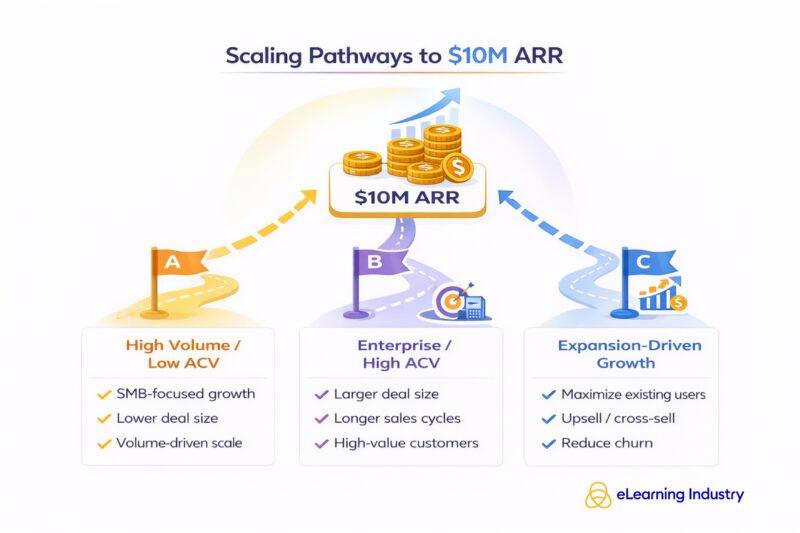
Path A: High Volume / Low ACV
The first path contains a model about high volume and low ACV. Specifically, this model depends on:
- Strong inbound marketing
- High conversion efficiency
- Automated onboarding
- Low-touch customer success
Potential risk: Churn volatility can destabilize growth.
In order for this pathway to work, you need operational excellence in acquisition efficiency.
Path B: Enterprise / High ACV
The second path includes an enterprise with high ACV model. In short, this model depends on:
- Vertical specialization
- Security and compliance strength
- Strong sales leadership
- Implementation capability
Potential risk: Long sales cycles create pipeline pressure.
This path is rather hard to make, but once established, this path produces durable ARR growth.
Path C: Expansion-Driven Growth
In the third path, we have the expansion-driven growth model. This is the compounding model.
In fact, this model depends on:
- Modular product design
- Clear upsell pathways
- Customer success maturity
- Strong retention metrics
Fast-scaling learning tech companies on this path often achieve the strongest net revenue retention rates. The reason is that this pathway mathematically accelerates ARR growth.
Why Visibility And Authority Accelerate Scaling
Visibility and authority accelerate scaling. Hence, it is a fact that at the growth stage, buyers behave differently.
To be specific, potential buyers in the market:
- Research extensively before engaging
- Compare vendors deeply
- Evaluate leadership credibility
- Assess long-term viability
Therefore, authority becomes a very important revenue lever.
Brand Reduces CAC
Brand strategy is not only important in marketing; it also affects other aspects of a business directly. Hence, when your brand is visible:
- Sales cycles shorten
- Inbound improves in quality
- Win rates increase
- Pricing pressure decreases
Companies with low branding tend to try to sell harder. On the other hand, recognized vendors with solid branding sell smarter.
Authority Influences Enterprise Decisions
Authority is equally important to branding when it comes to revenue. In this sense, enterprise buyers ask:
- Is this vendor stable?
- Is it recognized in the market?
- Is it a thought leader?
- Will it still be here in five years?
The importance of authority in the market is that it answers these questions before the first sales call. In short, scaling revenue requires scaling visibility.
Thought Leadership As Pipeline Strategy
Thought leadership in a scaling business is not just another marketing technique to increase traffic and visibility. It is a pipeline strategy that affects revenue directly.
Fast-scaling learning tech companies understand its value and:
- Publish data-driven insights
- Share executive perspectives
- Contribute to industry conversations
- Position leadership publicly
In this important stage, authority becomes an acquisition channel. Hence, it is not vanity; it is conversion leverage.
The Structural Difference Between Stalled And Accelerating Companies
In this section, we will present the structural differences between stalled and accelerating companies. Let’s compare.
Plateaued Companies
- Broad positioning
- Reactive sales strategy
- Inconsistent pipeline coverage
- Rising CAC
- Weak expansion discipline
- Founder bottleneck
For these companies, growth becomes an exhausting process.
Accelerating Companies
- Clear vertical focus
- Defined ICP
- Predictable GTM systems
- Strong NRR
- Enterprise credibility
- Executive-level leadership
On the other side, for winning companies, growth becomes a mathematical process.
Why Scaling To $10M ARR Changes Strategic Optionality
Crossing $10M ARR transforms a learning tech company’s market position.
In short, scaling signals:
- Product-market durability
- Revenue predictability
- Enterprise readiness
- Strategic maturity
- This milestone impacts:
- Investor perception
- Acquisition attractiveness
- Partnership opportunities
- Market leverage
Scaling to $10M ARR strengthens long-term acquisition readiness, but more importantly, it increases strategic independence.
The Compounding Effect Of Repeatability
Fast-scaling tech companies understand something fundamental:
Revenue acceleration is not about intensity; it is about repeatability.
When you have:
- Clear ICP
- Predictable acquisition channels
- High net revenue retention
- Strong expansion motion
- Structured leadership
- ARR growth compounds.
On the other hand, when you lack these, then growth stalls regardless of effort.
The $1M To $10M ARR Mindset Shift
The milestone from $1M to $10M ARR requires a mindset shift as well as an organizational one.
To specify, at $1M ARR you prove the product works. However, at $10M ARR you prove the company works.
The main difference here lies in:
- Systems over hustle
- Clarity over flexibility
- Focus over breadth
- Retention over acquisition obsession
- Discipline over experimentation
Consequently, the long jump is structural, not tactical.
Accelerate Your Path to $10M ARR
eLearning
Conclusion
In this article, we covered the long journey from $1M to $10M ARR as the most defining growth phase for learning tech companies. To reach this milestone, companies need to focus on the following:
- Positioning precision
- Repeatable go-to-market systems
- Retention-driven expansion
- Investment discipline
- Leadership evolution
The pitfall here is that most companies stall between $2M and $5M ARR because they attempt to scale tactics instead of building systems. Fast-scaling learning tech companies treat revenue as infrastructure.
In short, they:
- Define clear revenue targets
- Align GTM to a narrow ICP
- Invest in predictable channels
- Protect net revenue retention
- Build executive depth
That is exactly how ARR becomes compounding rather than fragile.
Enterprise buyers research before engaging. Visibility influences trust. Trust shortens sales cycles, and shorter sales cycles accelerate ARR.
For learning tech and HR tech vendors scaling toward $10M ARR, market positioning is no longer optional; it is strategic infrastructure.
High-intent demand, executive visibility, and industry authority help transform growth-stage momentum into durable revenue acceleration.
FAQ
At $1M ARR, growth is often founder-led and opportunistic. At $10M ARR, growth requires structured go-to-market systems, a defined ICP, predictable pipeline coverage, strong retention metrics, and executive-level operational discipline.
Companies typically plateau due to broad positioning, inefficient acquisition channels, weak differentiation, inconsistent pricing discipline, and lack of expansion strategy. Without repeatable systems, growth slows despite increasing effort.
No. Product-market fit validates demand, but $10M ARR requires scalable infrastructure, predictable sales systems, defined customer targeting, and disciplined capital allocation. Operational maturity becomes more important than product innovation alone.
Key metrics include net revenue retention (NRR), gross churn, LTV/CAC ratio, pipeline coverage, average contract value (ACV), and CAC payback period. At scale, retention and expansion matter more than new logo acquisition alone.
Positioning becomes a growth multiplier. Fast-scaling learning tech companies narrow their ICP, own a clear category narrative, and sell measurable outcomes rather than features. Sharper positioning improves win rates and lowers CAC.
Enterprise deals can significantly accelerate ARR due to higher ACV, lower churn, and multi-year contracts. However, they require stronger operational maturity, security readiness, and structured sales processes.
Net revenue retention is one of the strongest predictors of sustainable scaling. Companies with 110–130%+ NRR can compound ARR faster because expansion revenue reduces dependency on constant new customer acquisition.
Typically between $2M–$5M ARR. Scaling requires delegated revenue ownership, defined accountability, and experienced leadership capable of building repeatable pipeline systems.
Fast-scaling companies invest in proven acquisition channels, avoid premature hiring, fund operational infrastructure early, and prioritize leadership hires that strengthen revenue predictability.
At higher revenue stages, buyers research vendors extensively before engaging. Market authority, thought leadership, and brand visibility reduce CAC, shorten sales cycles, and increase enterprise credibility, accelerating ARR growth.