I REALLY Think Secondary ELL Teachers Should Consider Radically Restructuring Classes, But I’m Not Sure If They Are
Early this year, I wrote Does Advanced Tech Mean That Secondary ELL Classes Should Be Radically Restructured?
In it, I wondered if, because of the advances of Google Translate and Google Lens, if secondary teachers of ELL classes should, after students advance beyond Newcomer and early Intermediate, if the primary emphasis should then be on speaking and listening.
An interesting guest column in the LA Times by a world language teacher makes similar points, though he focuses on the advances in oral translation. In June, when I wrote my original post, even I had not anticipated the extraordinary advancements in oral translation technology.
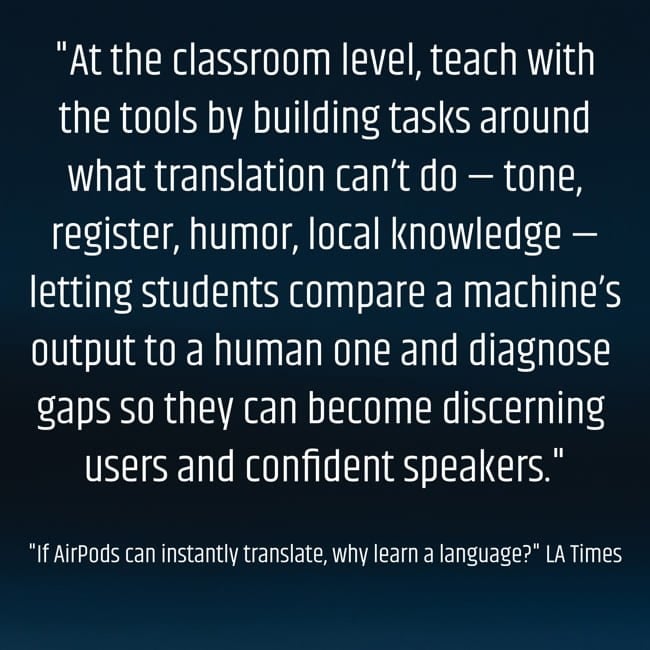
In his column, If AirPods can instantly translate, why learn a language?, he suggests that simultaneous translation tools suggests that educators need to teach speaking and listening differently, too:
At the classroom level, teach with the tools by building tasks around what translation can’t do — tone, register, humor, local knowledge — letting students compare a machine’s output to a human one and diagnose gaps so they can become discerning users and confident speakers. Most importantly, tie language learning to real jobs: pair classes with internships in clinics, courts, newsrooms and nonprofits. Students who see their skills matter keep learning — and they graduate into roles where those skills pay dividends for all of us.
I think he’s right, and I still stick with what I wrote in my original post.
I do hope that ELL instructors are thinking about these points. If not, I’m afraid they’ll end up in a situation similar to what has been facing thousands of college instructors who are having difficulty adapting their instruction to the world of AI – teacher frustration and student dissatisfaction.
I’m adding this info to The Best Resources For Learning The Advantages To Being Bilingual.