Ohio State Quickly Finds a President
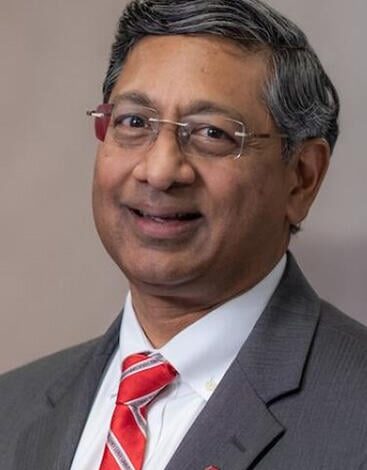
Ohio State University moved quickly to find its new president, elevating Ravi Bellamkonda from the administrative ranks to replace Ted Carter, who stepped down in scandal mere days ago.
Bellamkonda, who served as executive vice president and provost since early 2025, will take the job on a permanent basis after the Board of Trustees unanimously approved his hire Thursday. In hiring Bellamkonda, the board sidestepped a traditional search process, which typically takes months. Trustees said little in the Thursday morning board meeting about why they decided against a national search.
Instead they highlighted Bellamkonda’s depth of experience and character.
“The right leader is already at our university,” board chair John Zeiger said. “His vast experience, his personal values and management skills, his strong record here at Ohio State, and his ability to inspire excellence in all those around him give this Board of Trustees confidence that Ravi Bellamkonda is the right person to lead this university into the future as our president.”
Bellamkonda will now take on a job that will require him to navigate thorny donor issues, the lingering fallout of a sexual abuse scandal and the far-reaching effects of Ohio’s Senate Bill 1, which has forced institutions to shed low-enrollment programs, established post-tenure review policies and mandated institutional neutrality on controversial topics, among other measures.
He will reportedly earn a base salary of $1.4 million annually over a five-year term, more than the $1.1 million–a–year base for his predecessor.
The Hire
Bellamkonda quickly ascended to the presidency after joining the university last January.
A bioengineer by training, Bellamkonda spent three-plus years as provost and executive vice president for academic affairs at Emory University. He also worked at Duke University, Georgia Tech and Case Western Reserve University. Bellamkonda received his undergraduate degrees from Osmania University in India, was a postdoctoral fellow at the Massachusetts Institute of Technology and earned a Ph.D. at Brown University.
In his introductory remarks, the new president touted the mission of Ohio State, from its research enterprise to its athletic programs, and noted the strong support for the university.
“What binds this wide cross-section of our community is their love for Ohio State and, importantly, their recognition that Ohio State as the flagship land-grant university plays a critical role in our state’s economy, and they recognize the power of Ohio State to positively impact the citizens of this great state,” Bellamkonda said. “When a [first-generation] student graduates from Ohio and Ohio State, they are transformed.”

Ravi Bellamkonda, President of The Ohio State University
The Ohio State University
Now he will step into a presidency that has proven hard to hold on to in recent years, with his immediate predecessors lasting just two to three years. Carter stepped down after roughly two years because of an “inappropriate relationship” with a woman who wanted to use public resources to benefit her private business. Before Carter, President Kristina Johnson also stepped down after less than three years on the job, reportedly due to tensions with the board. Her decision to leave may have been related to her efforts to sideline Les Wexner, an Ohio State megadonor with close ties to convicted sex offender Jeffrey Epstein.
Bellamkonda said trustees asked him about taking the job Sunday night, before Carter’s resignation was announced. He also nodded to the search controversy in his remarks after the meeting.
“I know our faculty—and I’m one of our faculty—have concerns about due process and shared governance, and as a provost, I have fully committed to shared governance … But here we are, and I will try to do the best I can to be the best steward for all constituencies, including our faculty,” he said in response to a question.
Bellamkonda also fielded a question about diversity, equity and inclusion efforts at past stops. While state laws have limited DEI initiatives at Ohio’s public universities, Bellamkonda emphasized his belief that pluralism and intellectual diversity are beneficial in higher education.
“I do believe that our brains are sort of prediction machines. They have a model of how the world works, and learning happens the minute you run into an idea, a notion, a perspective, a culture that you have not experienced before,” he said. “And at that moment when you have a certain view of the world, and you run into such things—which we do at universities—and I’ve consistently said it is very valuable to have at the university a plurality of opinions and perspectives, and so I am committed to that principle.”
He also addressed the role of donors, a topic that looms large at Ohio State, where many in the campus community have called on the university to split with Wexner over his ties to Epstein.
“From athletics … from academics to our health-care mission, we really couldn’t be the excellent place that we are without our donors, and certainly Les and [his wife] Abigail [Wexner] have been great supporters of the university for many years and have served the university,” he said.
Bellamkonda added that he had already been a part of conversations about the naming of campus facilities, an area of controversy, given that Wexner has his name on medical facilities. As Ohio State has reportedly fielded more than 300 requests to review whether Wexner’s name should remain in place, he noted a “thorough, fair and open” process is in place to do so.
“And I will promise you that we will give each request a full consideration,” he said.
Process Concerns
The sudden hire caught many in the Buckeye community by surprise.
The Ohio State American Association of University Professors chapter expressed disappointment over the lack of transparency in hiring and the decision to forgo a search, noting that the board did not consult with faculty, staff or students before tapping a new leader.
“Ohio State’s system of shared governance—not to mention best practices in hiring university presidents—requires all of us having a say in the process. This hasty, undemocratic process starts this presidency on the wrong footing and sends the wrong message about our supposed shared values,” the Ohio State AAUP chapter said in a statement posted on social media.
The group also raised broader concerns, alleging that the institution has chilled free speech, and called on Bellamkonda to “repeal Ted Carter’s anti–free speech policies, listen to abuse survivors, and commit to greater transparency and authentic shared governance going forward.”
While the sudden hire without a formal search is unusual for a public institution, it’s not unprecedented. In 2022, Purdue University tapped then–engineering dean Mung Chiang to replace the retiring Mitch Daniels via a secretive selection process. One key difference is that Daniels’s exit was scheduled, appearing to make Purdue’s search more deliberative despite its secrecy.