Pacifier Weaning – Helping Your Child Give Up The Soother

Pacifier weaning can be stressful for a child and their parents. Here are 17 tried and true ways to help your child give up the soother.
Weaning a toddler off a pacifier is one of the most common parenting challenges, so it’s a topic that I’m often asked about. Thankfully, it’s also a topic that I get a lot of great advice about as well.
Pacifiers, also known as soothers, Nuks, paci’s and dummies (depending on your location in the world) can be a real blessing when your baby is young.
Eventually though, if a child doesn’t give the pacifier up on his own, there usually comes a time when the parent wants their child to give up this much-loved comfort item.
Many parents think that getting a child to give up their pacifier will be so stressful that they allow their child to keep using it. However, as every day passes, the child becomes more attached to and dependent on it, making it even harder to take it away.
If you’re thinking it’s time to get your toddler off the pacifier, I have some suggestions that will help to make it virtually stress-free.
I recently asked my Facebook followers for their best tips for taking the pacifier away, and I’ve put together a list of helpful tips based on their advice.
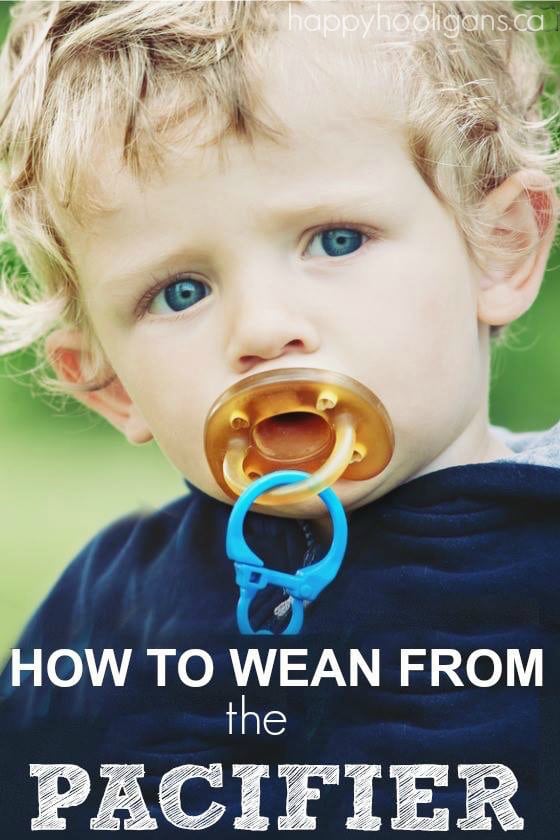
Child with soother via Shutterstock
First of all, let me say that there was an outpouring of support for letting a child continue to use a pacifier, and allowing the child to decide when to give it up. I’ll share some of those snippets with your first:
- One reader said “Our doctor told us that babies like their pacifiers just like we like our own pillows.” It is comforting, so wait until they past the 1 year mark to remove it.
- Pacifiers are thought to reduce the risk of SIDS.
- Most babies like pacifiers because they do actually pacify and calm the child. However, if your baby is waking numerous times a night, rather than just popping the soother back in, check to see if your child is actually hungry.
- If your baby loses his his pacifier in the night, try leaving several in the crib. That way, they can just reach and grab another one.
But if you’ve decided that it’s well and truly time for your child to say bye-bye to the binky”, read on…
Pacifier Weaning – 17 Tried and True Solutions
(each of the following points come from our awesome readers that have been there…)
- Keep a small bowl of soothers in the corner of your child’s crib. Teach your child to put his soothers in the bowl they get out of bed. This helps your child associate the pacifier with sleep-time. It also helps them know where to find the pacifiers if they lose theirs in the night.
- Only allow the soother at nap time and bedtime. It will be easier to wean your toddler off it when the time comes, and it your child will actually look forward to going to bed.
- Have the “pacifier fairy” collect all of your child’s soothers, and leave a special gift in their place.
- As soon as your child is asleep, remove the pacifier from his mouth.
- While weaning, put all pacifiers in a hard-to-get-at place, so YOU can’t easily cave and get one when you’re frustrated and exhausted.
- Offer your child a cuddly alternative to a pacifier. A soft, lightweight blanket or a stuffed animal can provide comfort. Every time she cries for her soother, pat her back, stroke her head and tuck the new comfort item into her hand. This can take up to 3 nights but it will work.
- Use a noise machine to help your child sleep more soundly. The less your child wakes up in the night, the less they’ll cry out for their soother.
- A popular trend is to have the pacifier sewn into a stuffed animal when your child is through with it.
- If your child associates their soother with nap time, consider waiting until they give up their nap.
- Buy a special toy for naptime, like a snuggly new princess toy or superhero toy.
- A new nightly tradition can distract a child who is missing his soother, like a special bedtime story or a warm cup of milk.
- In exchange for the pacifier, give your child a new nightlight and a special pillow.
- Use a sticker chart. Give them a sticker each time they wake up in the morning without crying for their pacifier at bedtime.
- Read books, such as Bye Bye Binky by Brigette Weninger or Bea Gives Up Her Pacifier by Jenny Album. (affiliate)
- Cut off the top of the pacifier, and let them hold the plastic part of the pacifier.
- Let them listen to a book on tape, before bed, to help them focus on the book and not the pacifier.
And the easiest way to wean a toddler off the pacifier:
I received the following pacifier-weaning tip dozens of times because parents everywhere have had success with this simple trick. Even my own daycare families have done this, and it’s worked:
The easiest way to break your child of the soother habit is to snip a small hole in the pacifier with a pair of scissors.
When your child sucks on the pacifier, there won’t be enough suction to provide comfort or satisfaction. Your child will let you know this, and you can simply explain that their soother is broken and must be thrown away. You’ll want to snip ALL of your soothers so your child won’t have a backup supply that works. Your child will quickly lose interest in his broken soother, and voila… your child’s pacifier days are over.
Books to help with Pacifier Weaning:
Here are some board books that can help prepare children for giving up the pacifier for good:


Hopefully one of these suggestions will help to make pacifier weaning a brief and stress-free transition for your child.
In the end, just remember to be patient. Remember that whenever and however you decide to take the soother away from your child that it should be at a time and in a way that’s right for your family.
Good luck!
Solutions to more parenting challenges:
Follow the Hooligans on Facebook

Jackie is a mom, wife, home daycare provider, and the creative spirit behind Happy Hooligans. She specializes in kids’ crafts and activities, easy recipes, and parenting. She began blogging in 2011, and today, Happy Hooligans inspires more than 2 million parents, caregivers and Early Years Professionals all over the globe.