SUNY Service Corps Fights Food Insecurity in New York
As food insecurity continues to rise across New York, the State University of New York’s public service program has stepped in to address the growing need.
The SUNY Empire State Service Corps, a paid, student-driven initiative with more than 500 members, has ramped up its on-the-ground efforts in recent months.
Launched in May 2024, the group was funded with $2.75 million from the state budget and is New York’s largest AmeriCorps program. SUNY Corps students assist New York residents in high-need communities with K–12 tutoring, Supplemental Nutrition Assistance Program and basic needs outreach, peer mental health support, sustainability projects, hate and bias prevention, nonpartisan civic engagement, and FAFSA completion.
SUNY chancellor John B. King Jr. said the program played an integral role during the federal government shutdown this fall as New York residents faced cutbacks to federal food-assistance benefits.
“The threats to the SNAP program presented a huge challenge for New York,” King said. “Many of our food pantries saw a significant uptick in usage before the shutdown, and then certainly during the shutdown as people anticipated not being able to access SNAP benefits.”

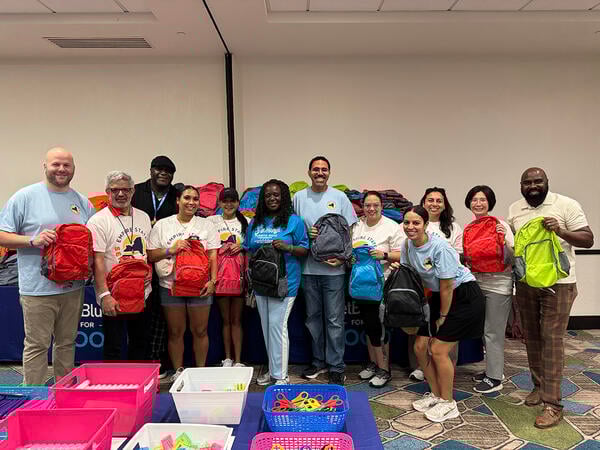
SUNY chancellor John B. King Jr. (center, in light blue shirt) joins students and staff as they pack backpacks with supplies for New York elementary students.
State University of New York at Binghamton
In response, New York governor Kathy Hochul provided $200,000 in additional funding to bring on more SUNY Corps students to help families at risk of losing aid. The funding will support the added students for the remainder of the academic year.
King said the additional paid hours were essential and allowed campuses to quickly mobilize students to support food pantries and community centers.
“Many of our students know what it’s like to be in a situation where your family finances feel incredibly fragile,” King said. “So when our students see classmates who are food insecure, who are skipping meals in order to make ends meet or who are distracted in class because they’re hungry, they worry a lot about them.”
Inside the Service Corps
SUNY Corps students dedicate at least 300 hours to paid community service and are eligible to receive an AmeriCorps Segal Education Award of up to $1,500.
“They’re from every part of the state, every socioeconomic background, every ethnic background, every faith background, and they are excited to work together to make the community better,” King said. “It’s exactly what we should be doing in higher ed, and it’s exactly what we need as a country.”
More than 500 students from 45 SUNY campuses participated in the program this year, and interest continues to outpace availability; applications exceeded campus placements by more than three to one over the last two years.
Sarah Hall, an Empire State Service Corps coordinator and senior assistant director at the State University of New York at Binghamton, said her campus received more than 200 applications for just 50 spots this year.
“Every time I talk to a student who is part of our Empire State Service Corps, you can really feel how meaningful this is to their own personal and professional growth,” Hall said. “I really think this is setting them on a path of service in their future.”

Sarah Hall, an Empire State Service Corps coordinator at SUNY Binghamton.
State University of New York at Binghamton
Following the federal government shutdown, Hall said, her students quickly mobilized a meal kit assembly effort after Hochul provided the additional funding.
“We purchased over $4,000 worth of food … so when families go to a pantry or food bank, they’re able to just pick up an entire meal that will feed a family of four,” Hall said, adding that her students put together more than 560 kits.
Beyond Binghamton, the first cohort of SUNY Corps students statewide, logged over 100,000 hours of service and served more than 70,000 New York residents during the 2024–25 program year.
“It’s a reflection that young people really want to serve and want to contribute to the community and are eager for these opportunities,” King said.
What’s Next
The chancellor said the government shutdown underscored how essential sustained investment in public service programs will be in the years ahead.
“I’d love to see federal investment in this space,” King said. “There continues to be bipartisan support for the AmeriCorps program, so my hope is that we can continue to grow national service efforts around the country.”
He noted that New York was recently selected as one of four states—along with California, Colorado and Kentucky—to join the Service Year Alliance, an inaugural cohort seeking to grow the number of paid service opportunities throughout the United States.
Looking ahead, King said the SUNY Empire State Service Corps could serve as a model for colleges and states seeking to build or expand their public service initiatives because it’s “highly replicable.”
“There’s a lot of reasons for people to feel discouraged about the health of our democracy,” King said. “But when you’re with these students who are committing 300 hours plus a year to service, it makes you quite hopeful.”
Get more content like this directly to your inbox. Subscribe here.