Teacher Tips for Creating a High School Student Resume
21
Whether they’re applying for college or a job after graduation, knowing how to create a resume and a cover letter is an important skill for every high schooler. These documents highlight their abilities, interests, educational background, and future goals, all while showcasing their professionalism.
But how can high school students craft a resume when they have little to no work experience? We’ve compiled our best tips on teaching high school student resume lessons, and included high-quality, no-prep resume templates for high school students to make your college and career readiness unit relevant in the modern professional world.
Streamline the resume format
The first step in creating a resume is understanding that, despite its many details, it should be straightforward. Students and first-time resume writers often fall into the trap of “more is more,” adding too many details and making their resume look more like a five-paragraph essay than a scannable professional document.
Use resume templates for high school students to model the (ideally) one-page structure of the typical resume, including bullet points, margins, and other formatting requisites. More technologically savvy students can format their resumes to make them more readable and distinctive, as long as they understand that this is an “at-a-glance” document, not an autobiography.
Follow a straightforward career readiness template
Many things have changed since teachers’ generations applied for jobs, but the value of the resume isn’t one of them. Show students how to showcase their skills and interests with templates that help them create resumes, cover letters, and other important professional documents.

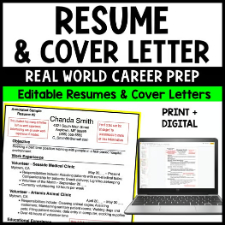
Resume Writing Template and Cover Letters for Career Exploration Activity
By Caffeine Queen Teacher
Grades: 10th-12th
Subjects: Business, Economics, Family Consumer Sciences
Get students started on a high school career exploration unit with a resource addressing each step. Use digital and printable templates for cover letters and resumes to help students craft their first career materials, and have them double-check their work with rubrics and work choice cheat sheets.

Resume Writing Template
By Literacy in Focus
Grades: 7th-10th
Subjects: Business, Writing
It doesn’t get more basic than fill-in-the-blanks! Show students how and where to fill in their contact information, work experience, education and awards, interests, and references with a straightforward resume template. Print out the form for students to fill in, or have them use the worksheet as a rough draft before designing their own format with the same information.
Keep the basics brief
Resumes should get a little more in-depth than “name” and “contact information,” but not too much more. The basic parts of a high school student resume should include:
- Name and contact information (email and phone number)
- Educational experience (including GPA)
- Work and/or volunteering experience (if any)
- Extracurricular activities
- Skills (soft and hard)
- Awards and honors
- Interests
- References
Each section should be brief and include as few words as possible. Remind students that employers or college admissions officers should get an idea of who they are by just glancing at their resume. And if students love to write, just wait till they get to the cover letter!
Write resumes thoughtfully and deliberately
When you think about it, writing a resume is like any other writing assignment in your class, except this one might be what gets students the job they want. Help them apply academic writing perspectives to a resume by applying academic standards and approaches when they create this important document.

Resume & Cover Letter Writing + Templates—College & Career Readiness Activities
By Jenn Liu — Engaging to Empower
Grades: 9th-12th
Subjects: School Counseling, Writing
Use a no-prep career preparation resource to teach high schoolers about writing cover letters and resumes, all through the lens of the 5E approach (Engage, Explore, Explain, Elaborate, Evaluate). Two complete lesson plans take teachers and students through the process of creating professional documents, while samples, templates, and scoring guides included in the resource instruct students on the proper form of each one.

Resume and Cover Letter Writing for College & Career Readiness
By Tracee Orman
Grades: 11th-12th
Standards: CCSS W.11-12.1, 2, 4, 5, 6, 7, 10; L.11-12.1, 2, 3, 4; CCRA.W.1, 2, 4, 10; L.1, 2, 3
Aligned to writing and language CCSS and designed for a college and career readiness unit, this resource includes everything high schoolers need to write a resume and cover letter. Students use online editable Google Drive links to build their professional documents based on templates, rubrics, samples, and guidance for crafting polished interview materials.
Include soft and hard skills
Your college and career readiness unit should address the difference between soft and hard skills, especially as they relate to a student’s abilities in and out of the classroom.
Common soft skills to include on a high school student resume are:
- Communication
- Time management
- Problem-solving
- Flexibility
- Organization
- Leadership
Hard skills (industry-specific skills) depend on a student’s desired future career or interests, but often include skills like:
- Foreign language proficiency
- Coding and computer programming
- Creative and technical writing
- Artistic and musical abilities
- Scientific research and writing
Brainstorm different skills with students and find ways to include them in their resumes. This may include relevant examples or simply listing them in a “Skills” section for their future employer to read.
Find experience in extracurriculars
If a resume is a professional document, how do high schoolers create one without any professional experience? The key is finding experience in everyday activities, including extracurriculars, volunteering, class projects, and any other aspect of their life, and adding those activities to their resume in place of work experience. These activities are also great ways to show students’ soft and hard skills in an applicable way.
For example, club presidents and founders demonstrate leadership and initiative, but so do volunteers at summer camps or elementary reading programs. Students who complete long-term passion projects can pinpoint the collaborative skills they used along the way, while performing arts students can include the focus and dedication with which they approach every performance. And nothing says “teamwork” like being in a sport!
“One strategy I’ve found especially effective is having students create a ‘Love–Hate Business Plan.’ They identify the things they love to do and a problem in the world they wish did not exist, then design how they can use their unique interests and skills to make a positive impact, such as hosting a bake sale or craft fair to support ending world hunger. Once they see where they are headed, the resume becomes a living roadmap instead of a static document, and they stop asking, ‘What do I put on a resume?’ and start asking, ‘How do I build the experiences that align with the life I want?’”
– Lauren from English With Ease
Focus on the future
No matter how you organize it, a high school student resume isn’t going to have as much information as the resume of someone with more life experience. But students don’t need 20 years of working in the field to know what they want to do in life, especially if they use their current skills to craft a vision of their professional future.
Encourage high schoolers to use their resumes to tell a story about the future. How will they use those STEM skills from high school as engineers? What can they bring from student government to their future as lawyers? How can athletes use the lessons learned on the field as CEOs? Using language that focuses on their goals can make up for any lack of life experience reflected on their resume.
“Make life skills future-focused and action-oriented, and start with vision before logistics. When students realize they can design experiences instead of waiting for them, and that initiative builds resumes, confidence, and character all at once, life skills become transformational rather than mundane.”
– Lauren from English With Ease
Personalize the cover letter
A cover letter is a chance for students to fill in any blanks they may have left in their résumés. It’s the place where they can not only showcase their writing skills, but also address any lingering questions an employer or college admissions officer may have about them. Incorporate cover letters into your writing prompts for high school, and encourage students to reflect on their experiences.
Students should also personalize cover letters (and to some extent, resumes) to their readers, making connections between that specific organization and what the student can bring if they’re employed there. Different types of job opportunities may require different types of writing approaches. For example, someone hiring for a trade may want a cover letter that includes more practical and hard skills, while a person looking to fill an office internship may want to know more about a student’s personality in their cover letter.
“Lean into your students’ interests. Understand what careers they wish to pursue and tailor your lessons accordingly. For example, it’s important to know if your learners are pursuing trades apprenticeships or more office type roles.”
– Lynne from Northleo Writing Inc
Develop interview skills
High school student resumes are important, but ultimately, they’re just the first step in the job application process. Students will need to know how to use an interview to embody the person they’re representing in their resume (who is, ideally, an accurate picture of who they are).
Hold practice interviews for students to hand out their resumes and discuss themselves, their skills, and what they would bring to a hypothetical job. You can be the interviewer, peers can interview each other, or you can invite professionals from the community to listen to students interview. These conversations build important speaking and listening skills on top of the understanding that a resume is a jumping-off point for any professional endeavor.
Inspire high school professionalism with interview questions
Help students get to know each other (and themselves) with interview questions focused on their future careers. They’ll learn from each other as they answer each one, and hopefully build on their own interviewing skills in the process.

Conversation Starters for Middle and High School | Interview & Resume
By College Counselor Studio
Grades: 9th-12th
Subjects: School Counseling
Get high schoolers thinking and talking about their futures with a set of discussion questions on resumes, interviews, and careers. An easy-to-follow lesson plan takes students through the process, while the conversation starters help them both sort out their understanding and practice job interview skills with their peers.
Prepare for the modern work landscape
A lot has changed in the last 50 years of job seeking. Paper applications have made way for online forms, job duties are less important than measurable accomplishments, and with the introduction of automatic resume readers and AI applicant tracking systems, it’s never more important to keep professional materials relevant and scannable.
Most importantly, high school students should understand that the way to set themselves apart isn’t with fancy fonts or scented resumes, no matter what the movies tell them. People reading their resumes want to know that the person they’re hiring is competent, flexible, and eager to learn. That describes how high school teachers want to prepare their students to be, and exactly what high school student resumes should communicate.
Bring career exploration into every class
When students have college and career readiness infused into each of their classes, they’ll develop important high school life skills alongside academics. Whether they’re designing a high school student resume in social studies, researching salary potentials in math, or crafting a well-written cover letter in ELA, they’ll be ready for any next step they take after high school graduation.
For more college and career readiness materials, find more high school resume resources to help students showcase what they’ve learned—and what they hope to do in the future.